Tesla’s Cloverdale Supercharger Uses Grid Forecasts to Manage Charging Power
- Robert Garcia
- 886 views
The 8-stall California site can draw more power when the grid has capacity and scale back during peak demand, potentially shortening the wait for new stations.
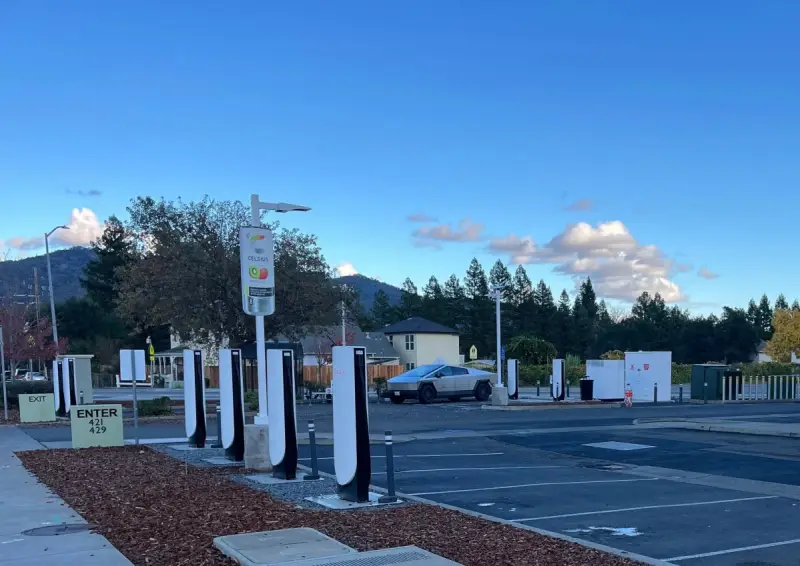
Tesla’s new Cloverdale Supercharger shows how flexible power limits could help charging sites open sooner. The 8-stall station can adjust its electricity use when the local grid is under pressure, allowing it to serve drivers before planned grid upgrades are complete.
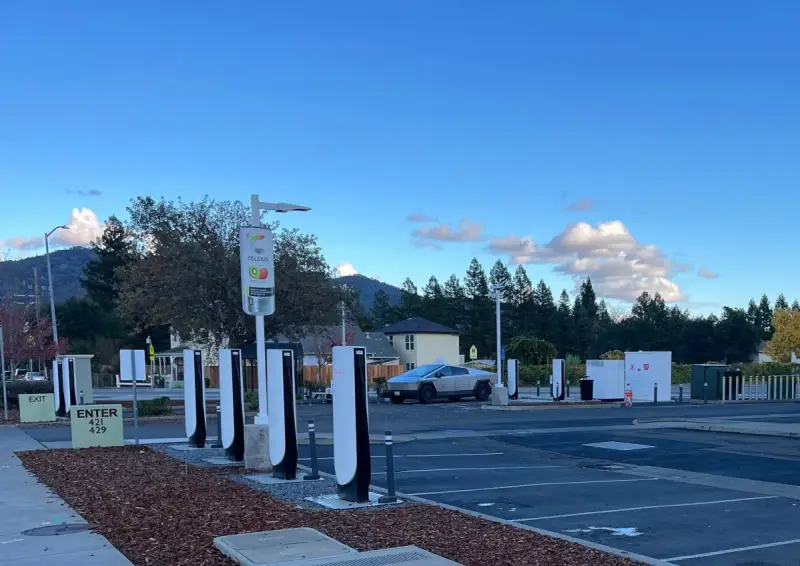
The site opened Monday at Penny Faire Plaza on South Cloverdale Boulevard, California, and is part of PG&E’s Flex Connect pilot. Tesla says the station communicates with the grid over the IEEE 2030.5 protocol. Its V4 stalls can deliver up to 500 kW, and the location is open 24 hours a day. Restrooms and food are nearby. Drivers of non-Tesla EVs can use the station with a NACS adapter.

Power limits that change with demand
A new fast-charging site may need more electrical capacity than the local grid can provide at every hour of the day. In that situation, the usual choices are to wait for grid upgrades or open with a fixed, lower power limit. Either can constrain a project: construction may be ready while the electrical connection is not, or the site may remain limited even when the grid has spare capacity.

Flex Connect offers a different arrangement. PG&E’s grid management system sends an hourly power limit forecast to a site’s energy management system a day ahead. The site can then alter its electricity use automatically, drawing more when capacity is available and reducing demand during forecast periods of strain.
PG&E illustrates the approach with a fast-charging site requesting 2 MW. A fixed limit could hold it to 0.5 MW all year because of a small number of peak-demand hours. Under Flex Connect, it could use the full 2 MW for most of the time and lower its draw when the grid needs headroom. Those figures describe PG&E’s example, not the Cloverdale station’s capacity.
That distinction matters for drivers. The pilot is designed to vary the site’s total power use according to grid conditions; the information available doesn’t specify how often Cloverdale will be asked to scale back or how that would affect charging times. A 500 kW rating identifies the maximum output a V4 stall can deliver, not a promise that every stall will always provide that rate. Actual charging depends on conditions at the site and vehicle.

What the pilot requires
Flex Connect is available to sites within PG&E’s service area that can adjust their electricity use and face grid upgrades expected to take longer than 12 months. The model treats power as something a charging operator can manage over time: a site can accept limits at certain hours in exchange for access to more capacity during the rest of the day.

For charging networks, that can change the timetable for opening. If a project can operate within a changing power allowance, it may not need to wait for every grid upgrade before serving customers. The tradeoff is that capacity becomes time-sensitive. Drivers could encounter different charging conditions depending on when they arrive, though no operating schedule or customer-facing limits have been detailed for Cloverdale.

A potential expansion tool for Tesla
Tesla has passed 85,000 Supercharger stalls across 9,000 locations worldwide. Connecting new sites to the grid remains one of the practical constraints on network growth, so opening stations ahead of upgrades could help the company add locations sooner in areas where the pilot applies.

The approach complements changes to station construction. Tesla’s pre-assembled Accordion Superchargers are designed to transport 16 stalls on one truck and are described as about 20% cheaper to install. Faster installation can shorten the build portion of a project; flexible power access addresses a separate bottleneck at the electrical connection. Neither change alone guarantees a faster opening, but together they target two common sources of delay.

Cloverdale provides a concrete test of whether dynamic power limits can make that combination useful in practice. For drivers, the station’s key details are already clear: eight stalls, V4 hardware rated up to 500 kW, round-the-clock access, and charging for non-Tesla vehicles with a NACS adapter. The next useful measure will be how consistently the site can deliver power as local grid demand changes.