Erin Marquis Makes Her Case for GM's Top Job
- [email protected] (Erin Marquis)
- 344 views
With Mary Barra nearing retirement age, Erin Marquis argues her GM background and blunt style make her the right successor. Her list of priorities is more useful than the pitch.

Mary Barra is approaching retirement age, and the succession question at General Motors is now a live one. Erin Marquis, who has covered the industry for Jalopnik, has decided the search committee doesn't need to look much further. Her pitch is tongue-in-cheek, but buried in the jokes is a usable checklist of what a GM chief executive needs to get right.
Start with the incumbent. Barra is GM's second-longest serving CEO and the first woman to run a major automaker. She took over in 2014, in the middle of the ignition switch scandal, and her early tenure was defined by a willingness to clean house. Marquis credits her with a firing spree that shook loose a lot of complacency and pulled the stock out of a nosedive. Whatever you think of the methods, a company in that position rarely recovers through caution alone. Any successor will be measured against that record, and that's the bar Marquis is aiming at.
 Kevin Dietsch/Getty Images
What the résumé actually shows
Marquis's real credential is her time inside the company. When Barra was named CEO, Marquis had just left a job at the Renaissance Center after three years on the agency side, working as a Creative Agency of Record. She led a redesign of GM's global website, GM.com, and then worked across five GM brands. Her favorite detail is the internal shorthand GM used for its discontinued nameplates, POSH: Pontiac, Oldsmobile, Saturn and Hummer, treated as a single brand for marketing purposes.
That's worth paying attention to. Brand portfolio is one of the hardest problems a large automaker faces. Lineups accumulate nameplates over decades, and each one carries dealer contracts, marketing spend and a loyal but shrinking customer base. Folding dead brands into a shared story is one way to test whether there's still demand for them. Marquis's view is that the demand is there, which is why her wish list includes bringing back Pontiac and Saturn. Whether that's a sound idea is another question, but it's the kind of question a CEO has to answer with data rather than nostalgia.
She's also pointed about the lineup itself. Her bluntest line is a call to cut the bloat, with a specific jab at parts of Chevrolet and all of Buick. Strip the rhetoric away and the underlying point holds: when brands overlap on price, size and buyer, the company spreads engineering, dealer attention and advertising too thin. Trimming that is painful, which is why it's usually left for a new leader to do.
The qualifications, read as a to-do list
Several items on Marquis's list are jokes about office life, such as surviving a Chevy ad executive's font-size complaints and navigating the Renaissance Center without getting lost. Others are sharper. She says she'll never try to kill the Chevy nickname, a dig at the company's habit of pushing its brands in directions customers didn't ask for. She also promises to bring electric models back, a reference to the EV programs GM has scaled back. Whether that's the right call is precisely the strategic debate facing the company, and a CEO will have to take a position on it that goes beyond a snappy line.
Two items point at real industry pressure. The first is data. Marquis says she'll never sell customer data, which is a reminder that connected vehicles now collect far more information about drivers than most owners realize. Automakers that build software and subscriptions into their cars have to earn trust on privacy, and that trust is hard to rebuild once it's lost.
The second is manufacturing. Marquis wants a strong production presence in Detroit, and she admits she isn't willing to drive far outside the city for much. The joke lands because it's a little true. Where a company builds its vehicles affects costs, labor relations, supplier networks and the story it tells about itself. Detroit is GM's identity as much as its balance sheet, so a successor who treats factory location as a serious question will be taking on real complexity.
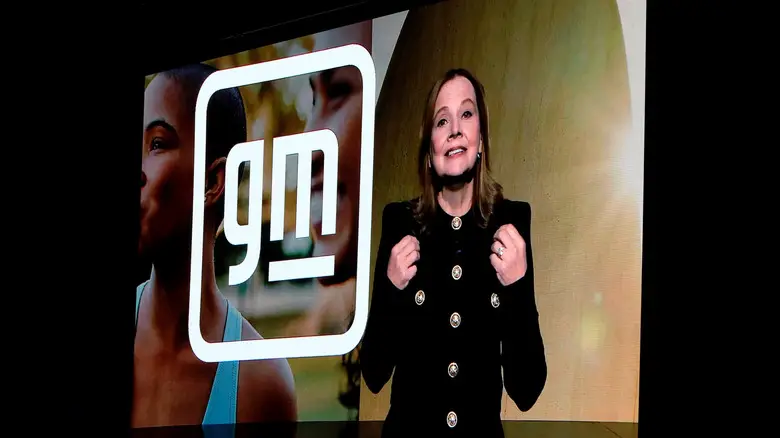 Ethan Miller/Getty Images
Why the pitch matters anyway
Marquis isn't going to be running General Motors, and the board is unlikely to be checking her references. But the pitch works because it describes the job accurately. A GM chief executive has to manage a brand portfolio that's too big for some markets and too small for others, pick an EV strategy that doesn't whiplash customers and dealers, protect the company's reputation on privacy and safety, and keep production close to the communities that built the company.
When a long-serving leader approaches retirement, this kind of transition tends to produce two questions: who can steady the ship, and who can change course. Barra's arrival answered the first with a ruthless version of the second. The next CEO will probably have to answer both at once, with a company that's healthier than the one Barra inherited but facing a very different set of pressures. My read is that the most useful thing in Marquis's essay isn't the résumé. It's the list of problems she thinks a successor has to solve. Those are the right problems, even if the candidate is a joke.


