Tesla Powercore Targets 7.4 MW for Megapack, Solar and Data Center Projects
- Thomas Davis
- 391 views
Tesla’s Powercore combines a transformer, inverter and breaker, with 7.4 MW continuous output and operation planned for 2027.
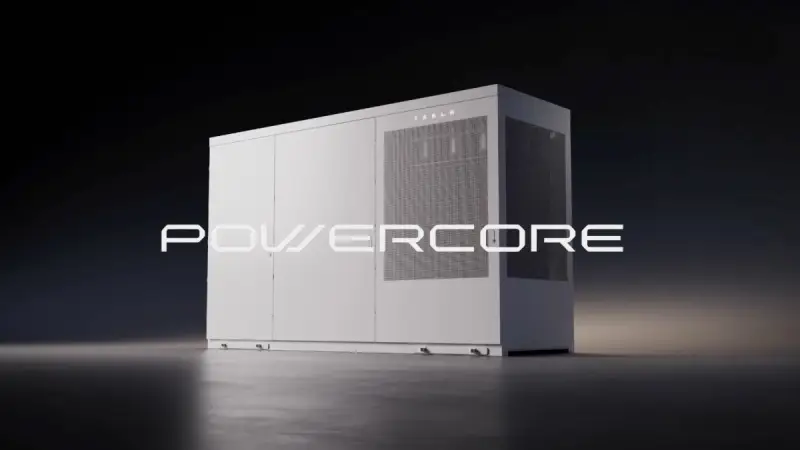
Tesla’s Powercore puts three major pieces of electrical equipment in one unit, aiming to simplify how large battery, solar and data center projects connect to power systems. The solid-state system is rated for 7.4 megawatts of continuous output, and Tesla plans to have it operating in 2027. Price and customer availability details haven’t been announced.
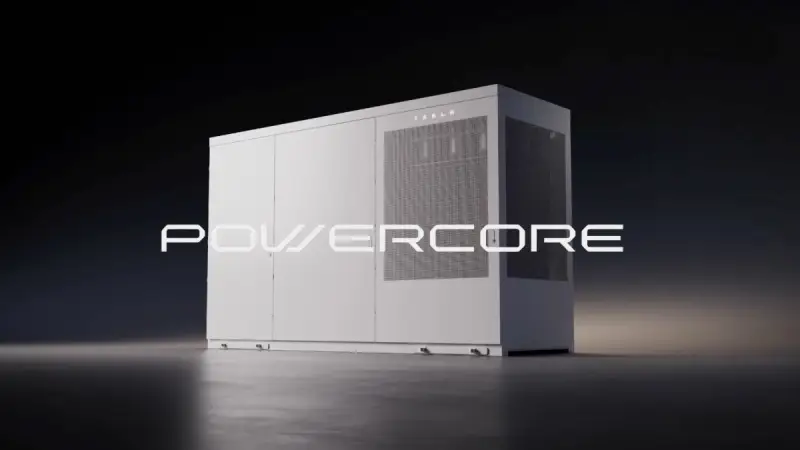
For energy project developers, the pitch is practical: combine a medium-voltage transformer, inverter and circuit breaker in one enclosure, then connect the unit to storage or other electrical infrastructure. That could reduce the amount of separate equipment and on-site electrical work a project needs. The actual benefit will depend on how Powercore is configured and integrated at each site.

Power ratings and electrical range
Tesla specifies 7.4 MW of continuous power at 34.5 kilovolts AC, with a rating of 9 megavolt-amperes. The company also cites grid-forming support for peak power up to 10 MVA. Those figures describe different electrical ratings, so they shouldn’t be treated as interchangeable measures of continuous output.

Powercore is designed to accept DC voltages from 800 to 2,000 volts and AC voltages from 10 to 34.5 kilovolts. That range gives the system room to serve installations with different electrical configurations, while its intended role is to manage conversion and connection between equipment and the wider power network.

The name “solid-state transformer” points to the conversion technology at the heart of the product. Traditional large installations often use separate transformers and inverters, alongside protective equipment. Bringing those functions together could make a project’s electrical layout more compact and reduce the number of interfaces installers need to connect. The announcement doesn’t provide dimensions, weight, efficiency figures or installation-cost estimates, so those details will matter when buyers compare the system with conventional arrangements.

Protection and grid support
Powercore includes a solid-state circuit breaker. Tesla says it can interrupt electrical faults in 100 microseconds, which the company describes as about 1,000 times faster than traditional equipment. That is a manufacturer claim; project operators will still need to assess how the breaker performs within the complete installation and its protection design.
The system’s grid-forming capability is intended to help manage voltage and frequency. When paired with battery storage, Tesla says Powercore can also provide reactive power support and synthetic inertia. These functions can help storage systems contribute to network stability, beyond simply taking in electricity and sending it back out. The announcement doesn’t quantify how much support a particular installation could provide.

Tesla gives an operating temperature range of minus 40 to 55 degrees Celsius and says warranties of up to 25 years will be available. Those figures could be relevant for projects exposed to wide temperature swings, though the company hasn’t described warranty terms or how operating conditions affect performance.

Designed around Megapack
Powercore is intended to connect directly to Megapack batteries through DC bus connections. Tesla’s stated aim is to deliver more of the electrical system preassembled, reducing work required at the project site. That approach follows the company’s broader effort to package storage and medium-voltage equipment together through its Megablock platform.

Tesla previously outlined plans to make transformers internally when it introduced Megapack 3 and Megablock in September 2025. Powercore extends that effort with a dedicated unit that combines conversion and protection functions. For buyers, closer integration may simplify coordination between battery equipment and its grid connection, but project-specific engineering and installation requirements will remain part of deployment.

That distinction matters because a packaged system doesn’t remove the need to design around a site’s power requirements, connection voltage and other equipment. Its appeal will come down to whether the integrated package saves time or complexity compared with sourcing and connecting separate components.

Data centers, solar and charging
Beyond battery installations, Tesla lists solar farms, EV charging infrastructure and data centers as potential uses. For AI data centers, the company says Powercore can convert medium-voltage electricity directly to 800-volt DC, reducing the number of conversion stages needed to supply servers. Fewer stages could simplify the power path, though Tesla hasn’t provided efficiency or cost comparisons.

Tesla is working with NVIDIA to qualify Powercore under the company’s DSX Ready program for AI infrastructure. That effort places the product in a market where data center operators are looking for ways to deliver power to dense computing installations. Qualification details and timing haven’t been disclosed.
Timing and open questions
Tesla unveiled Powercore at the RE+ energy conference in Las Vegas on November 17, 2026. The company says the product will be made in the United States, with operation planned for 2027. Pricing, production capacity and the timing of first customer deployments remain unknown.
Those gaps matter for buyers weighing Powercore against conventional transformer and inverter setups or other integrated systems. Tesla has also said Megapack production was nearly sold out for 2027 and that it was working to increase output. If Powercore is intended to scale alongside Megapack, manufacturing capacity and delivery timing will help determine how quickly projects can use the combined approach. For now, the key measure to watch is whether the promised integration translates into simpler installation at the stated power ratings.


