The 1994 Electric Honda Civic That Helped Shape Tesla’s First Roadster
- [email protected] (Michael Frank)
- 849 views
AC Propulsion’s battery converted Civic tested technology later used in the tzero and licensed for Tesla’s first Roadster.
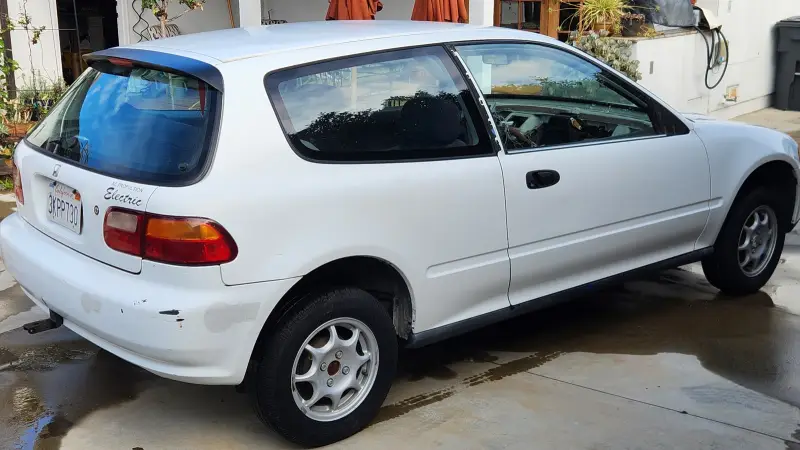
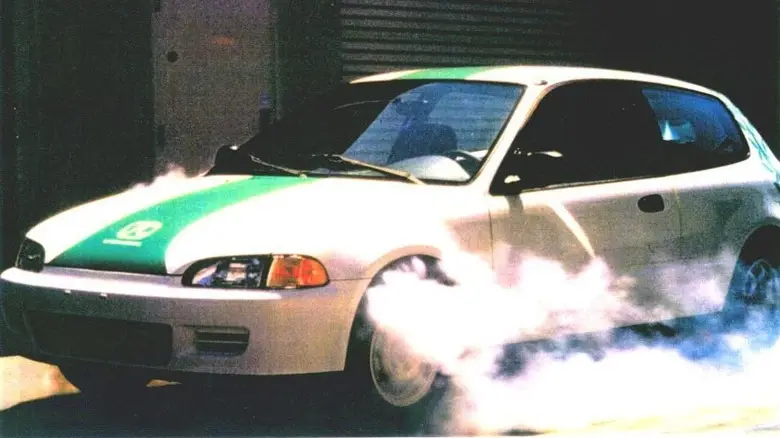
The 1994 Honda Civic that AC Propulsion co-founder Alan Cocconi converted to electric drive is an unlikely starting point for the original Tesla Roadster. Yet the small hatchback served as an early test bed for the power electronics and electric drivetrain concepts that moved from AC Propulsion’s tzero to Tesla’s 2008 sports car.
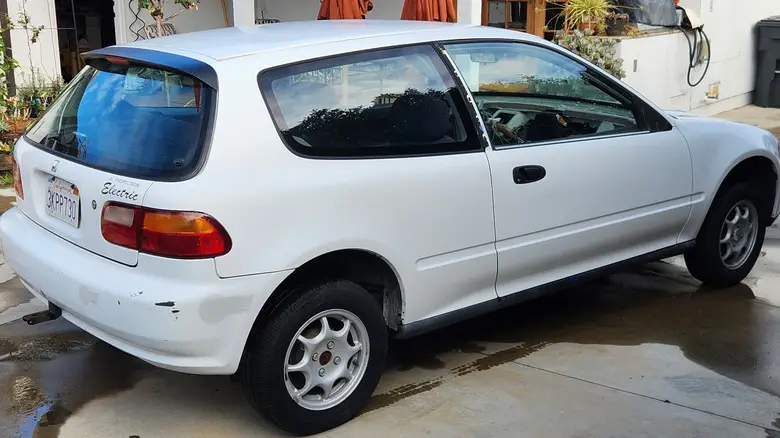
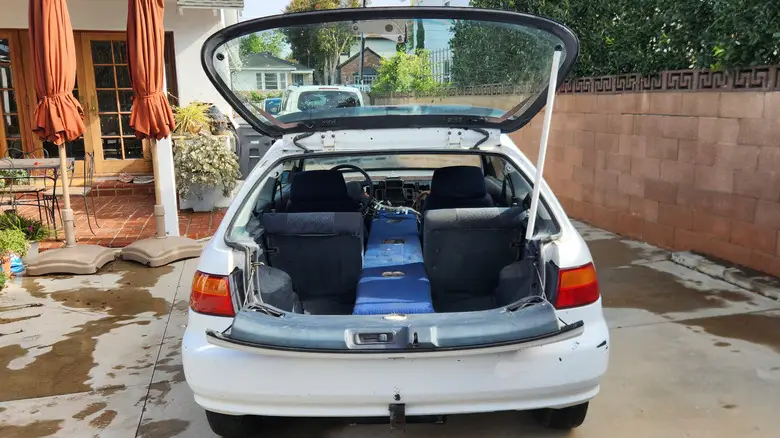
AC Propulsion’s former CEO Tom Gage sold the Civic recently, passing along a machine that had spent years out of service. Its importance lies less in its age or appearance than in the engineering packed beneath its bodywork: Cocconi removed the original powertrain, installed heavy lead-acid batteries and built a system that connected the car’s battery, motor and charging equipment.
The route from that experiment to Tesla wasn’t a straight march toward mass-market electric cars. AC Propulsion was working through practical problems—battery weight, range and performance—while also trying to show that an electric car could feel more like a sports car than a golf cart. The Civic and the tzero became milestones along that path.
One set of electronics for driving and charging
The Civic’s power electronics unit brought several functions together. Gage says Cocconi designed inverter hardware that converted the battery’s DC current into high-frequency AC to run the motor. When the car was plugged in, those same components reversed the flow, changing grid AC into DC to charge the battery.
That approach reduced the need for separate equipment to handle propulsion and charging. The system also supplied 12-volt DC power for the vehicle’s conventional electrical components. AC Propulsion called the assembly a power electronics unit because it included the motor and inverter, charger and low-voltage supply rather than just a drive motor.
The Civic carried an early version of a system rated at 200 horsepower, according to Gage. That figure helps explain why the car could deliver performance that challenged its modest appearance. The technology also anticipated a capability that remains less common in production EVs: sending electricity from a vehicle back to a home or the grid. AC Propulsion cars eventually supported power flow of up to 20 kilowatts. The article also cites the 2027 Ford Fathom as capable of supplying 10 kW without a wall inverter.
Battery mass led to a trailer generator
Lead-acid batteries made the Civic’s electric conversion possible, but they came with a severe weight penalty. The pack alone weighed 1,200 pounds, and Gage says the completed car exceeded the chassis’s gross vehicle weight limit. Range was limited, too, making the combination of useful distance and manageable mass a problem AC Propulsion had to address early.
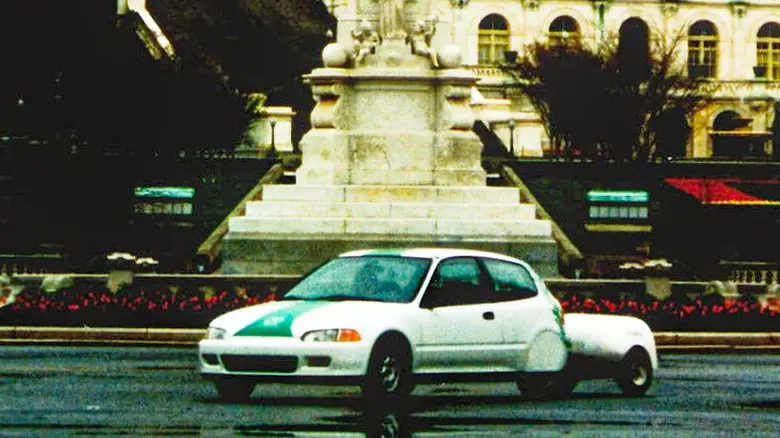
The company’s workaround was a trailer carrying a gasoline engine and generator. The engine didn’t drive the wheels; it generated electricity to replenish the batteries while the electric motor propelled the car. That made the setup a series hybrid, with the combustion engine serving only as an onboard power source. A trailer could carry the generator without requiring it to fit inside the Civic.
AC Propulsion tried different generator arrangements, including a modified Generac unit. Gage recalls that it had an unpleasant exhaust smell and didn’t produce much power. The team later used an engine from Kawasaki’s Ninja 250 motorcycle, which ran at 11,000 rpm. It was noisy, Gage says, but the Civic reached a reported 81 mpg with the generator setup.
Later, AC Propulsion adopted lithium-ion laptop batteries. That shift helped remove the need to tow a gasoline generator and addressed the weight and range compromises that had shaped the Civic’s early development.
The tzero connected the experiment to Tesla
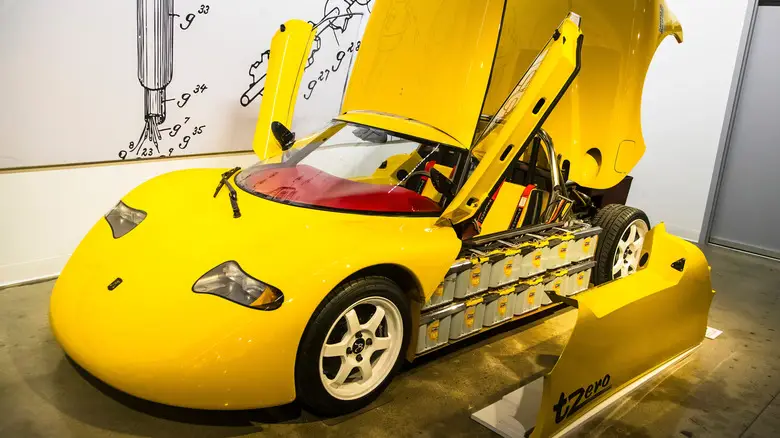
AC Propulsion moved from the Civic to the tzero, an electric sports car introduced in 1998 that initially used lead-acid batteries. The tzero’s shape mattered as much as its drivetrain in attracting attention. It used the Piontek Sportech kit car body, which helped make the car look unlike the golf-cart stereotype Gage says electric vehicles then faced.
Even with lead-acid batteries, Gage says the tzero could accelerate from zero to 60 mph in the four-second range. The Civic was just as quick, according to the account, but the tzero’s sports-car form made its performance easier to sell as a vision of what an EV could be.
In 2003, AC Propulsion fitted the tzero with lithium-ion batteries. Gage says the change increased its range from 80 to 100 miles to 300 miles while cutting 600 pounds. That combination of greater range and lower weight caught the attention of Tesla co-founder Martin Eberhard, who became an early AC Propulsion investor and wanted to buy a tzero.
Building the car in volume wasn’t practical at the economics AC Propulsion faced. Gage says each tzero would have needed to sell for $220,000, while the company was losing $100,000 on every car it made. Eberhard still wanted to build a sports EV. Gage and Cocconi were seeking investment from Elon Musk for a different ambition: a low-cost, high-utility vehicle. Gage recalls that Musk was more interested in a car like the tzero, so he introduced Musk to Eberhard.
In 2004, AC Propulsion licensed tzero technology to Tesla. That technology later featured in the 2008 Tesla Roadster, making the Civic part of the engineering lineage behind Tesla’s first production sports car.
Scion eBox work and a Nissan detour
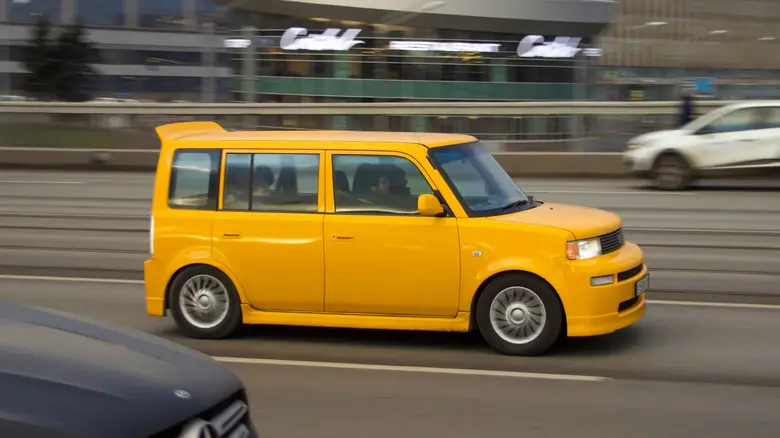
AC Propulsion also converted Scion xBs into electric vehicles called eBoxes. Gage says the first-generation xB appealed because it was inexpensive, practical and roomy enough to accommodate batteries. Its upright shape also made it easy to get into the rear seats. The second-generation model was substantially heavier, however, reinforcing the importance of a light base vehicle to the finished EV.
The company explored working with Nissan after the Scion project. Gage says Nissan engineers visited several times to drive the eBox and inspect its design. AC Propulsion expected discussions about supplying rolling chassis or establishing another supply arrangement. Gage later came to believe Nissan was studying the company’s work as it developed its own electric car. The Leaf arrived a year or two later.
A new owner has the Civic
Gage worked in AC Propulsion’s battery division until 2011. By then, the Civic had been left in the company’s back lot. He bought it for $100, though it wasn’t running and an employee had already begun taking it apart in hopes of turning it into a race car.
Gage stored the car at his home in Southern California and considered converting it to lithium-ion batteries. He estimated that such a change could give it as much as 600 miles of range. Another idea was to fit high-power lithium batteries and use its 200-horsepower system for a much lighter electric performance car. Neither plan is confirmed as the new owner’s direction.
The buyer already owns another piece of AC Propulsion history: a Honda CRX converted by the company in the early 1990s. That gives the Civic a plausible home with someone familiar with the technology. Whether it returns to the road, and in what form, remains open—but its role in the development of electric sports cars is already clear.


