McLaren MCL-HY Enters Final Development Phase Ahead of 2027 WEC Debut
- John Dagys
- 831 views
McLaren is bringing all six drivers into upcoming MCL-HY tests as it fine-tunes the car and prepares to settle its two-car lineups.

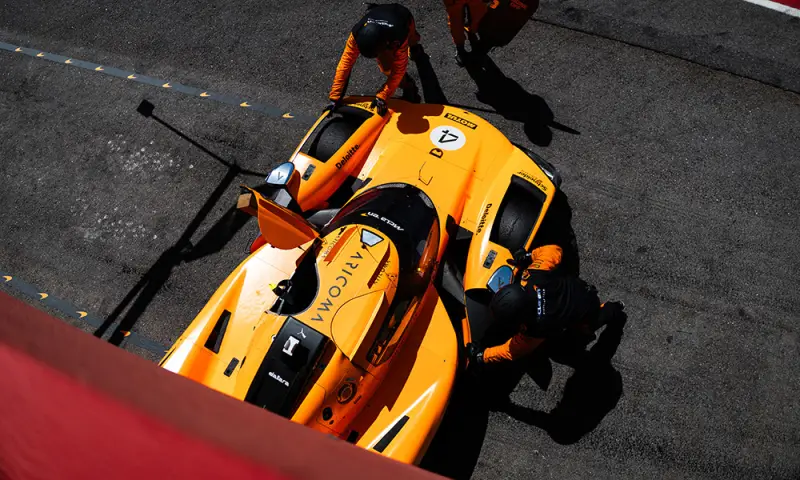
Photo: Drew Gibson/McLaren

McLaren’s MCL-HY program is moving from individual car development toward preparing the full team to race. With its six-driver roster and car specification now set, the British manufacturer plans to run both cars and bring all six drivers together during its next phase of testing, ahead of a planned FIA World Endurance Championship Hypercar debut in 2027.
Team boss James Barclay described the shift at the 6 Hours of Monza. McLaren has two tests scheduled before the end of the year, including a session at Portimao later this month. Barclay said the work will continue across the car and team operations, with the full driver group attending the upcoming test.
That makes the sessions more than a chance to collect further running data. They give McLaren an opportunity to assess how its drivers work together, develop the team’s procedures and begin matching people to the two-car effort. The manufacturer has not yet confirmed the final driver combinations. Barclay said the end-of-year European tests will be used to place drivers in groups and settle those pairings.
Fine-tuning before homologation
The MCL-HY uses a Dallara chassis, and Barclay said it is approaching the final stage of homologation. The team considers the main specification largely established, with no fundamental changes planned to the aerodynamics or powertrain. The remaining work is focused on details: drivability, aerodynamic balance and other refinements that can affect how consistently the car performs.
There is a practical trade-off at this stage of a prototype program. Continuing to pursue performance can consume time that might otherwise go toward checking reliability. Barclay said McLaren intends to keep developing the car until the last opportunity, while completing the final checks on its specification. The target is to reach homologation with a package that offers the desired balance and is ready for the demands of endurance racing.
For drivers, drivability and balance matter across a wide range of stint lengths and conditions. A car that responds predictably can help a team build confidence in its setup and make it easier for several drivers to share the same machine. The upcoming group tests should give McLaren a better chance to evaluate that broader picture than sessions focused only on developing parts.
One development car, with a two-car plan ahead
McLaren has used a single development chassis since the MCL-HY’s first rollout at Varano in May. Barclay said that was a deliberate choice: the team wanted to validate and finalize parts before committing resources to running two cars. In his view, concentrating development time on one car first helps the team get comfortable with its components before expanding production and testing.
That approach differs from fellow 2027 Hypercar entrant Ford, which has already tested two ORECA-chassied LMDh cars after its first rollout in August. The contrast reflects different timelines and development strategies, rather than a simple measure of progress. Barclay said a later start might have pushed McLaren toward doubling up its efforts with two cars, since parallel running can accelerate learning. Starting earlier gave the team room to concentrate on its parts first.
Moving to two cars will add more than another set of laps. It gives the team a chance to assess how its processes work across both entries and to build familiarity with the operational demands of a larger program. The tests with all six drivers should also help McLaren understand how the group fits together before it locks in pairings.
Three drivers remain the default
Malthe Jakobsen, Gregoire Saucy and Leonardo Fornaroli are the latest additions to the roster, joining Mikkel Jensen, Laurens Vanthoor and Alex Lynn. Barclay expects the driver groups to be determined by the end of the year, after the final two scheduled European tests.
McLaren has not ruled out adjusting its lineups, but Barclay said the team’s starting preference is to run three drivers per car. He pointed to the consistency that can come from keeping a three-person group together, and said that approach matches what he sees among leading competitors. The team is especially mindful of preparing for the 24 Hours of Le Mans, where the driver lineup and its shared preparation will be under sustained pressure.
Barclay likened the challenge to asking a group of golfers to prepare for a major event when one has had less practice than the others, then expecting the same performance. His point is about shared preparation: regular work as a group can help build familiarity before the biggest race of the year. McLaren’s forthcoming tests will show how that preference translates into its final pairings and race plans.
Test schedule retains room to change
McLaren has also planned further testing in the Middle East early next year, while keeping flexibility in case the location needs to change. Barclay said the team is watching how circumstances develop and has other options under consideration. The schedule therefore remains adaptable, even as the late-year European tests provide the immediate focus.
The next clear markers are the Portimao run with the full roster, the second scheduled European test and the confirmation of driver groups. Together, those steps should move the MCL-HY from a development project toward a two-car operation with defined roles. McLaren’s pace of progress will depend on getting that final mix of car refinement, reliability work and team preparation right before its 2027 debut.


