Dallara Says It Can Support Four Hypercar Brands Under 2030 Rules
- John Dagys
- 577 views
Dallara says it can serve four manufacturers at the same level in 2030, though car design freedoms and costs will shape what that support requires.

Dallara believes it can support four manufacturers in the Hypercar class under the rules planned for 2030. The Italian constructor’s capacity will depend on how much freedom the regulations allow teams to take with their cars, and whether each manufacturer chooses a distinct design.

“From what we know today, yes, no problem, we can serve all four of our [current] customers, in the same top level,” Dallara’s Max Angelelli said. He cautioned that the technical rules and manufacturers’ plans are still unsettled, making the scale of the work hard to define.
Four manufacturers could mean four distinct cars
Dallara currently works with BMW, Cadillac and McLaren on LMDh based prototypes, and supplies the chassis for Ferrari’s 499P LMH. The company expects to add McLaren as a fourth OEM from next year, and Angelelli said Dallara could maintain support for all four through the 2030 rules cycle if they remain with the constructor. He also said one could be replaced by another brand.
The potential workload depends in part on a design question that has not yet been settled: whether each OEM can use a unique spine, or whether cars will continue to share a common spine as they do under the current LMDh framework. Angelelli said two options were discussed at Le Mans: a unique car for each manufacturer or a shared approach.
If all four Dallara customers choose unique cars, the company would need to develop four separate designs at the same time. The amount of technical freedom will determine how far those cars can differ and how much engineering and production effort each will require. Angelelli said he believes Dallara could manage that scenario, while acknowledging that it would be demanding.
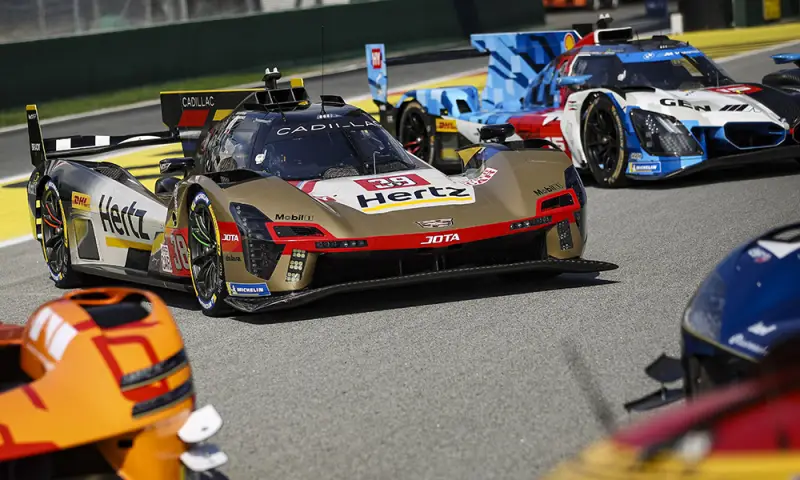
That work would be concentrated around a shared start to the new rules. “Unlike in the past, we will have four manufacturers starting the same race at the same time,” Angelelli said. Coordinating multiple new programs in parallel makes the timing and scope of the rules central to Dallara’s capacity assessment.
Cost remains a central concern
For Angelelli, the technical workload is only part of the challenge. The cost of competing under the next rules is another major concern, also raised recently by BMW and McLaren. BMW M Motorsport director Andreas Roos has argued for the 2030 regulations to stay as close as possible to the current LMDh rules.
Angelelli said the environment has changed since the current formula was developed around the period following the COVID pandemic. His point was that manufacturers and constructors need to keep the cost of racing within reach: “Everyone of us have to keep in mind that it cannot be crazy expensive like in the past. It would not work.”
That cost question connects directly to the design choices still under discussion. Greater freedom could allow manufacturers to shape more distinct cars, but it may also add engineering and development work. A shared architecture could limit the number of unique components and tasks. The eventual rules will determine how that balance affects both Dallara’s workload and the manufacturers’ budgets.
Rules timing and Hypercar participation
The draft regulations, initially expected by the end of this year, have been delayed until the middle of next year. Until the rules are settled, neither Dallara nor its customers can know exactly what each program will require or which direction manufacturers will choose.
Even with Lamborghini, Alpine and Acura withdrawing, nine brands are expected in the WEC Hypercar class next year. That level of participation gives the 2030 discussions a practical test: the rules will need to support manufacturers’ plans while keeping costs manageable enough for brands to commit.
Angelelli described cooperation among manufacturers, constructors and the bodies working on convergence as positive. Dallara’s present view is that four simultaneous programs are within reach, but the final answer depends on the design freedoms and cost structure written into the new regulations. Those decisions will show whether the current breadth of Hypercar participation can carry into the next rules cycle.


