2026 Subaru Trailseeker Review: An EV That Keeps the Wagon Spirit
- Zach Butler
- 530 views
The 375-hp Subaru Trailseeker is the brand's quickest current model, undercuts the Toyota bZ Woodland on price and keeps Outback-style proportions. Its real test is range.
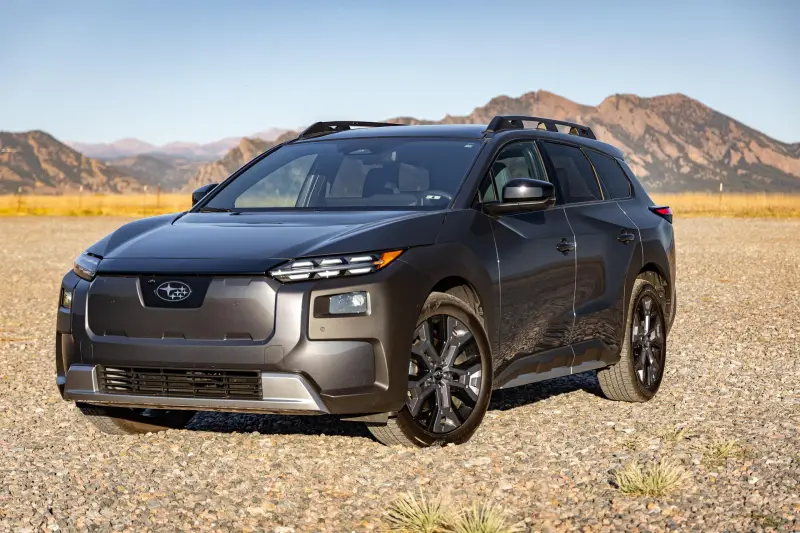
The Trailseeker matters for a simple reason: it's the most powerful Subaru in current production, and it still looks like a Subaru. Its 375 horsepower and dual-motor layout are the headline numbers. The proportions are the part that will get a lot of longtime Outback owners to look twice, because the current Outback has drifted toward a taller, more upright SUV shape. This car keeps the lower, wagon-like profile that built the nameplate's following.
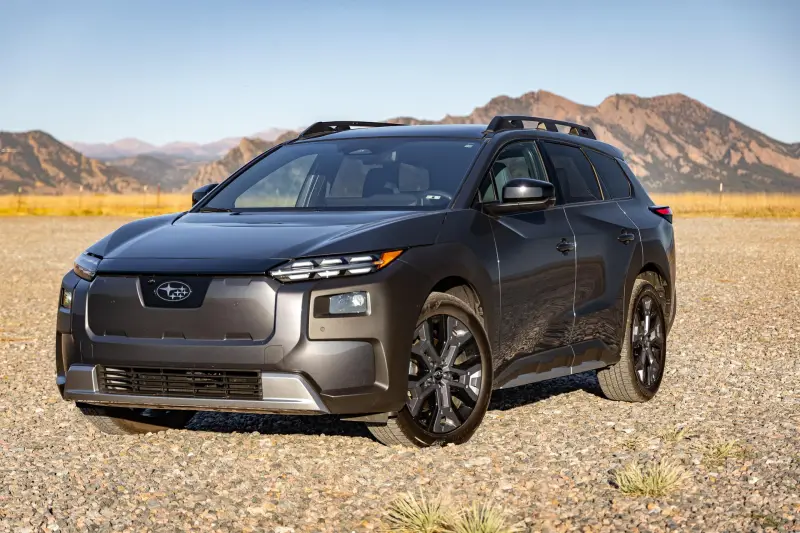
The real question is whether the EV package earns a place next to the gas-powered Outback and Forester in the showroom. My answer is yes, provided you can live with an electric drivetrain's trade-offs. Those trade-offs are mostly about range and charging, and I'll get to them.
Same bones as the bZ Woodland
Mechanically, the Trailseeker is functionally identical to the Toyota bZ Woodland. Subaru builds both at its Yajima plant in Gunma prefecture, Japan. Like the Uncharted (C-HR) and the forthcoming Getaway (Highlander), it came out of a joint development effort with Toyota. Trying to split hairs between the two on engineering is mostly a waste of time. The useful comparison is in the details: styling, interior tweaks, equipment and price.
I recently reviewed the Toyota bZ Woodland, so I spent time with both back to back. That comparison shapes most of what follows.
Exterior and proportions
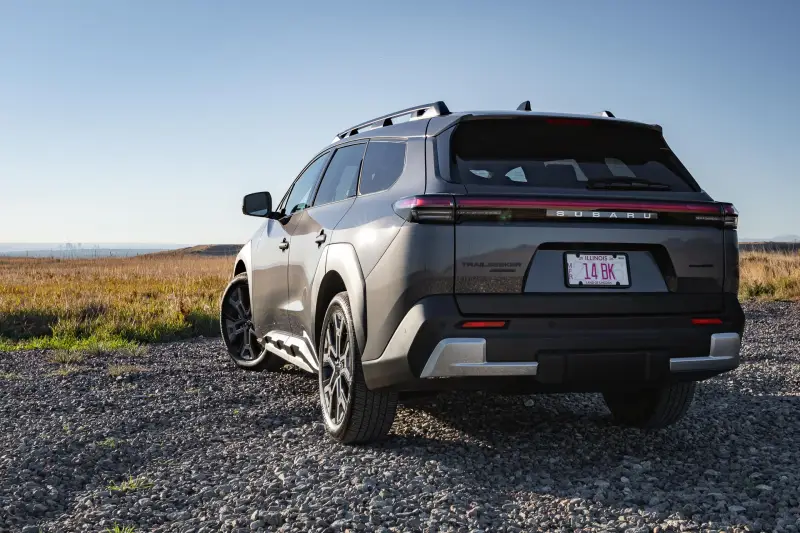
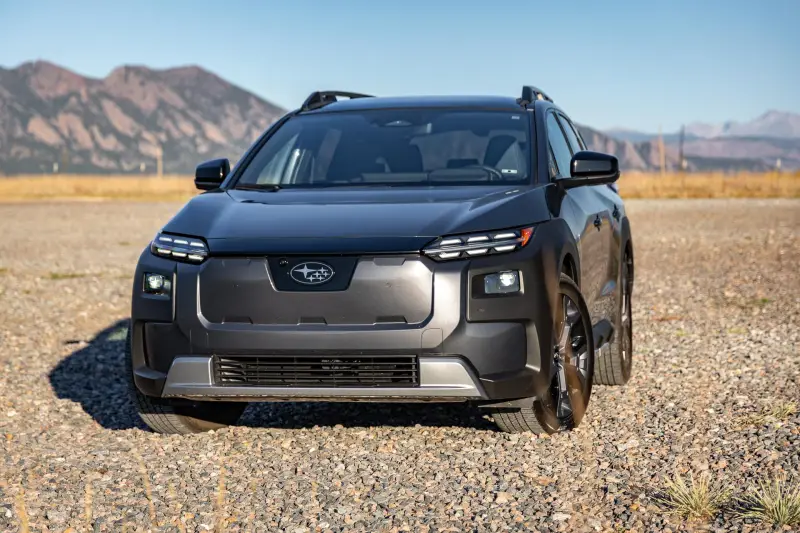
The Trailseeker's front end is more conventional than the bZ's. The running lights and headlight elements are more prominent, and the faux grille is broken only by a large Subaru logo, plus a front camera on Limited and Touring trims. The side profile is essentially the same as the Toyota's. Out back, you get Subaru lettering on the tailgate and a slightly different lower bumper.
I like the Subaru's look more. Toyota's new corporate styling reads as more car-like, while the Trailseeker has a more rugged stance. Your preference will decide this one, but the Subaru is the closer match for buyers who want an adventure-oriented wagon look.
Touring buyers can add a two-tone paint option with a black roof, and it comes at no cost as a package.
The Trailseeker shares its 112.2-inch wheelbase with the Solterra. Overall length is 190.8 inches, about six inches more than the Solterra. If you want the extra cargo space, the longer body is the way to get it, the same logic that separates the bZ from the bZ Woodland.
Cabin and practicality
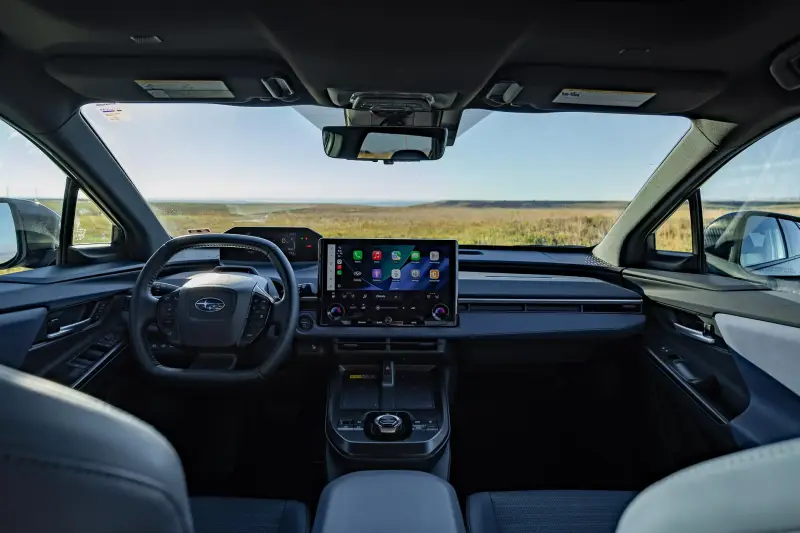
Our Touring tester came fully loaded, including the $300 leather upholstery option. It has a panoramic glass roof with a power sunshade, dual wireless charging pads, a 14.0-inch touchscreen and a 7-inch driver display. Apart from the steering wheel badge, the interior is functionally the same as the bZ Woodland. The differences are small but noticeable. The Subaru gets a three-stage drive mode button offering Eco, Sport and Normal, where the Toyota offers only Eco. The steering wheel is flat on the top and bottom.
For Touring trims, a contrasting blue and black leather option is available. Combined with metallic accents, it made the Subaru the more pleasant place to sit in my week or so of driving. That's a subjective call, but it's the one I'd make.
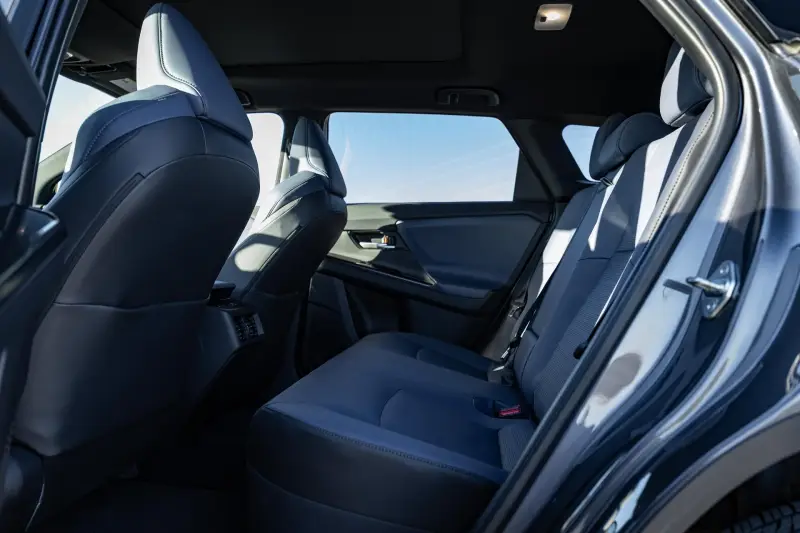
The weak spot for road trippers is the front storage. There's no glove box. Small items go in the center console or in the cubby below the gear selector and charging pads. That's workable, but the Outback offers more accessible storage up front, with a dual-level console, wider door pockets and a traditional glove box. The Trailseeker's strength is rear cargo, not front-seat organization.
Rear passengers do well. There are rear HVAC vents, dual USB-C ports, 35.3 inches of rear legroom and 38 inches of headroom with the panoramic roof. Two full-sized adults fit comfortably. The flat floor makes a middle seat more usable in a pinch, but I wouldn't plan on it for long trips. The bZ and Solterra have the same limitation.
Cargo volume is 71.8 cubic feet at maximum, and towing capacity is rated at 3,500 pounds.
Performance, with one asterisk
The Trailseeker's performance is strong, with one caveat. The 375 horsepower dual-motor setup gets it to 60 mph in an impressive 4 seconds. That's enough to break the standard all-season tires loose without much effort. As a WRX owner, I'll admit it's uncomfortable to say this, but the Trailseeker is about 1.5 seconds quicker to 60 than a stock WRX. That makes it the quickest Subaru in current production.
It isn't a sports car, and it isn't meant to be. A drive unit at each axle feeds power through Subaru's symmetrical AWD system. Combined with a curb weight of 4,510 pounds, that gives the car a neutral, predictable feel in most conditions. Push it hard and it will tell you about the weight. The Bridgestone Turanza tires don't help in the corners, though they handle confident passing maneuvers without drama, which is when the electric torque is most useful.
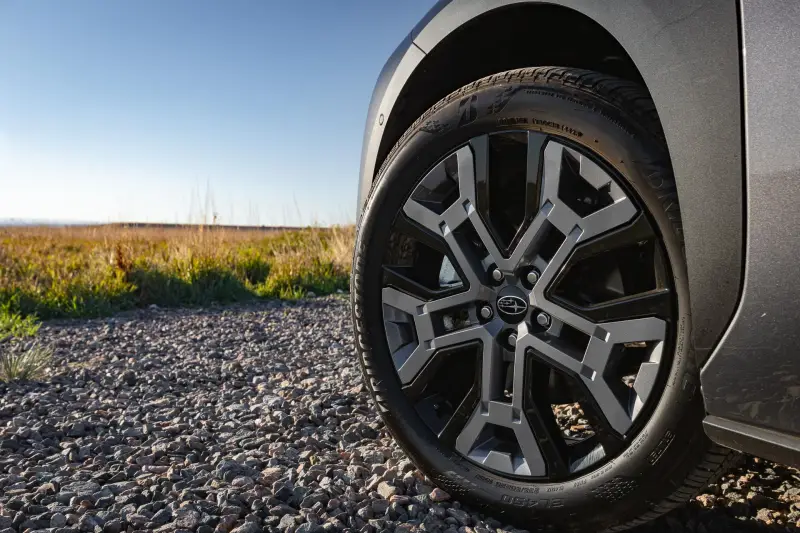
The tire choice deserves its own note. Toyota offers Dunlop Grandtrek all-terrain tires as a no-cost factory option on the bZ Woodland. Subaru doesn't offer an equivalent on the Trailseeker, which seems like an odd gap for a car marketed for adventure. Wheels go up to 20 inches, but there's no A/T tire option at the time of writing.
Range and charging
The all-season-only setup does have one practical justification, and it's range. The Trailseeker packs a 74.7 kWh lithium-ion battery under the floor. Subaru rates it at up to 274 miles on a charge, or 281 miles on the base Premium with smaller wheels. For most daily driving, those figures are more than enough. Road trips will depend on charger availability and planning, as they do with any EV in this class.
Charging is more modern than the older Solterra. The Trailseeker has a NACS port for access to Tesla's Supercharger network, and it supports plug-and-charge. It can take up to 150 kW under the right conditions, which lets it go from 10 to 80 percent state of charge in around 28 minutes. Intelligent battery preconditioning is now included, and that was a clear gap on the Solterra. The catch is that preconditioning triggers only when you use the built-in navigation to select a charger, or when you engage it manually. Make a habit of that before you rely on fast-charge times in cold weather.
The cabin is quiet at speed, and the ride is smooth and comfortable. The lack of all-terrain tires helps with road noise, which is one benefit of the on-road tire setup.
My biggest complaint applies to both the Trailseeker and the bZ Woodland: there's no true one-pedal driving. The paddles give you selectable regen levels, but moving from level 1 (coasting) to level 4 is abrupt compared with other EVs. The setting also resets every time you power-cycle the car, so you'll need to reselect your preferred level each time. For an EV that's trying to appeal to buyers switching from gas, that's a notable gap.
X-Mode and what it actually does off-pavement
X-Mode is Subaru's traction system for snow, dirt and mud, and it has been part of the brand's lineup for more than a decade. The Trailseeker uses a dual-function setup, with one setting for snow and dirt and a more aggressive one for deep snow and mud. Because electric motors deliver torque instantly and precisely, the system works especially well here. You can feed in low-speed power in a controlled way when traction is limited.
The Grip Control switch next to X-Mode works as a low-speed cruise control. Paired with Hill Descent Control, it lets you focus on steering on slippery descents. In light off-road use, the car pulls through tricky spots while the brakes slow whichever wheel is spinning and help keep forward momentum.
Ground clearance is 8.5 inches. That's about average for crossovers and fine for snow and forest roads. Combined with the car's length, it limits approach, departure and breakover angles, so extreme obstacles are off the table. For getting to most campsites, it's more than capable, and X-Mode adds real confidence. Our range test is still to come, so the figures on that front will need to wait.
Pricing and the bottom line
On price, the Trailseeker undercuts the bZ Woodland at every trim. The entry Premium starts at $41,445 including destination, compared with $46,750 for the bZ Woodland. The Limited, which is the trim equivalent to Toyota's base bZ Woodland, is $45,445 against $46,750. At the top, a fully loaded Touring with leather is $48,305, versus $48,995 for the Toyota.
Color choices include Magnetite Gray on our tester, Sapphire Blue Pearl, and Daybreak Blue Pearl for $395. A two-tone option with Crystal White Pearl adds $495.
If you compare the Trailseeker directly with the bZ Woodland, I'd lean Subaru. It looks better to me, it's cheaper at every trim, and the cabin touches are a small but real improvement. The Trailseeker is also the more natural heir to the older Outback's wagon formula, and that's the buyer it's aimed at. The real decision is whether you're ready for an EV. The range is fine for most daily driving, the charging has improved, and the car is genuinely quick. The missing one-pedal driving and the thin front storage are fair complaints, but they don't cancel the rest of the package. If the EV switch is a bridge too far, the gas Outback or Forester remain the right answer. If it isn't, the Trailseeker is worth a serious look.


