F1 Las Vegas GP: Driver plans, Cadillac pressure and Honda’s battery fix
- Josh Suttill
- 399 views
Alonso and Perez expect to leave before F1’s V8 return, while Cadillac faces operational pressure and Honda tests a battery countermeasure.
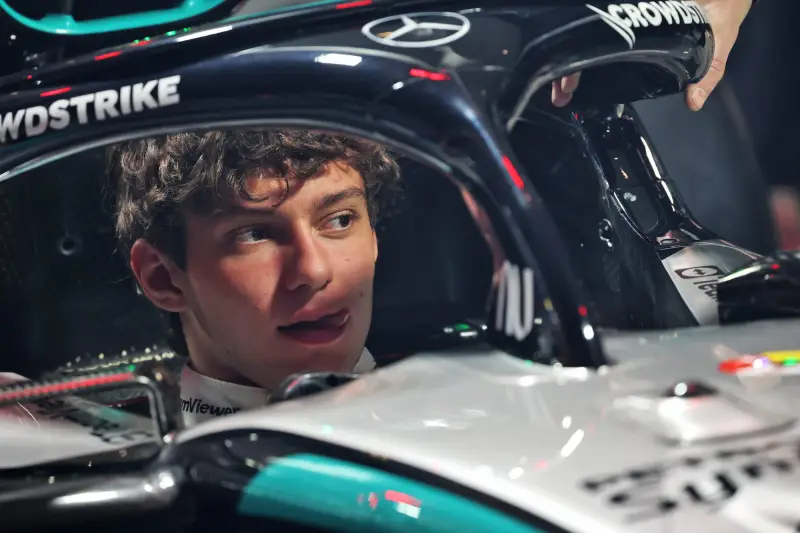
F1’s first day in Las Vegas put the focus on what teams and drivers need to sort out beyond a single race weekend: career timelines, car development, team operations and reliability. Fernando Alonso and Sergio Perez both ruled out staying until the planned V8 era, while Cadillac came under pressure to improve its execution and Honda tested a new response to recurring battery failures.
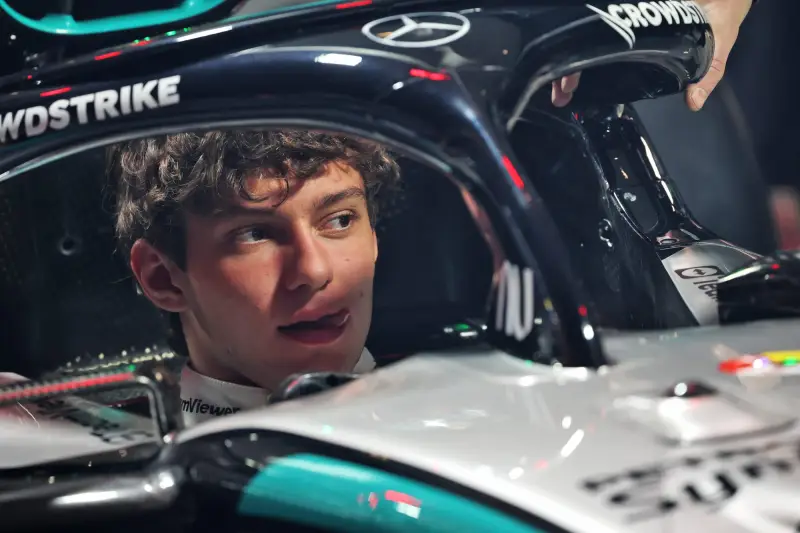
Alonso and Perez set limits on their F1 timelines
Lewis Hamilton has said he can imagine racing into the 2030s, but Alonso and Perez don’t expect to be on the grid when V8 engines return, currently anticipated in 2030 or 2031. Alonso, 45, was emphatic that he “will not be around for the new V8, 100%.” He also criticized the current V6 hybrid period, describing the years from 2014 until the V8 return as “16 or 17 years lost of pure racing.”
Perez is nearly a decade younger, but he also said he’s certain he won’t stay long enough to see the change. He plans to put everything into the final three years of his current period with Cadillac. After that contract, he said, he may have little energy left for F1.
The workload is part of the picture. Perez called his 2021–24 stint at Red Bull “very intense” and said he couldn’t remember a year as busy as 2026. For Cadillac, his comments also point to an immediate priority: the team needs to improve its performance and operations before thinking about the next generation of engines.
Biometric data draws different reactions
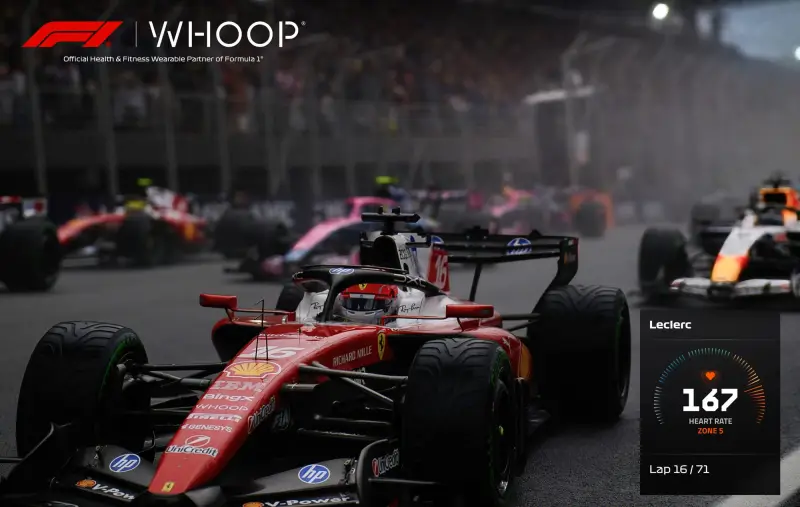
F1 plans to track drivers’ biometric data and show some of it during broadcasts from 2027 through a partnership with Whoop. Max Verstappen said he won’t take part, citing privacy and his reluctance to wear a device or have that information displayed.
George Russell sees potential appeal for viewers watching at home, but questioned whether heart-rate comparisons would tell them much. Drivers differ in age and physiology, he pointed out: a 45-year-old Alonso may have a lower heart rate than an 18-year-old, and even two people of the same age can differ. That makes a simple reading easy to misinterpret as a measure of calm or effort.
Charles Leclerc, already a Whoop ambassador who wears a device while driving for Ferrari, welcomed the availability of an FIA-certified version. The contrast suggests the broadcast feature may be useful to some viewers, but its value will depend on how the data is presented and explained.
Leclerc comments on a journalist’s accreditation
Leclerc said he was surprised by the wording of an article about him that contributed to a Daily Mail journalist losing media accreditation for the rest of the 2026 season. He described the phrasing as unexpected, while adding that criticism is part of the job journalists do and something drivers are accustomed to receiving.
Leclerc also said the decision on the journalist’s accreditation wasn’t his to make. His response separated his reaction to the language used about him from the decision itself.
Bearman waits on his 2027 position
Cadillac’s decision to retain Valtteri Bottas for 2027 leaves Ollie Bearman’s place as the main unresolved driver question described in Las Vegas. The 21-year-old has established himself as Haas’s lead driver over his first two F1 seasons, but said he was “quite disappointed” that his own deal hadn’t been settled. He called the situation strange and said he saw no excuse for the delay.
The complication is understood to involve negotiations between Bearman’s management and Ferrari about his longer-term role. If Hamilton and Leclerc both remain under contract, Ferrari may have no seat available for Bearman. A third season at Haas in 2027 still appears highly likely, but his place in Ferrari’s longer-term plans remains uncertain, as does any effect the negotiations may have had on that relationship.
Bearman reiterated that racing for Ferrari is his ultimate dream, while acknowledging that the future could bring challenges. For now, he said, he has limited influence over the outcome and will have to see how matters develop.
Russell’s remaining races may not expose his weakness
Russell arrived for the final triple-header in good spirits, saying Mercedes had brought its initially troublesome upgrade package into a better operating window. He was also pleased with his qualifying record against teammate Kimi Antonelli: Antonelli leads 11–9 in grand prix qualifying sessions.
Asked what would give him confidence in his 2027 platform, Russell joked that three wins would do nicely. More seriously, he has identified his main weakness as race pace at hot circuits, where tyre overheating becomes a problem. He said the issue is most pronounced on tracks with old tarmac and high tyre degradation.
The Las Vegas race is expected to be unusually cold, while Qatar and Abu Dhabi are night or sunset events. None of the three looks likely to recreate the hot-track conditions where Russell has struggled. That may help him carry momentum into 2027, but it also limits his chance to learn from the tyre behaviour that has hurt him this season.
Perez demands sharper execution from Cadillac
After Cadillac confirmed Bottas for 2027, Perez said the team could put the driver discussion aside and concentrate on its operations. He pointed to weak execution in recent races, including the team’s ability to deliver good pit stops, and said he had expected a much sharper performance by this stage.
Perez described the season as draining, with the effort of pushing the team compounded by driving a poor car. He also warned that Cadillac will face pressure next year if it doesn’t make a substantial improvement. Looking back at the start of the season, he said some people seemed content simply to be there and enjoy the experience.
His message was blunt: anyone at Cadillac who is satisfied with merely being part of the team has no place in an organization that intends to push hard and improve. The comments put the focus on the work ahead: cleaner operations and tangible progress will matter more than settling the driver lineup.
Antonelli’s settings give him more control
One strength behind Antonelli’s 2026 title is his willingness to make extensive changes to the car’s settings while driving. Mercedes technical director James Allison has described the young driver as adventurous with brake migration and differential settings. These controls affect how braking is distributed between the axles, how the car rotates into a corner and how it puts power down on exit.
Allison said Antonelli uses some settings at quite extreme levels to attack corner entry while keeping the car consistent as conditions change over a stint. Much of his lap-time advantage over Russell comes between braking and the apex.
Antonelli said he worked on these adjustments last year, but finds them especially powerful with the current cars. He tries to respond actively to tyre degradation, overheating and changing wind by adjusting brake balance, brake migration and differential settings. He’s still working on being quicker to make those changes, but expects the approach to remain useful over the next few seasons.
Honda tests a battery countermeasure
Honda has introduced a countermeasure for a battery reliability problem linked to retirements in recent races. The suspected issue concerns the battery’s main enclosure rather than a fault inside the battery itself. That resembles an earlier problem in which vibration inside the enclosure contributed to battery failures, though it may not be the same fault.
Trackside general manager Shintaro Orihara said Honda doesn’t expect the Las Vegas measure to solve the issue completely. The immediate goal is to learn more about the root cause. Honda has several possible explanations and has applied countermeasures, but Orihara said the team still needs to confirm which theory is correct.
That diagnosis matters for 2027, when Honda plans to use a redesigned battery. Pinpointing why the current setup is failing should help the company check that the problem won’t carry over. Las Vegas offers a demanding test: the long flat-out section from Turn 12 to Turn 14 is expected to put the Honda power unit under particular strain.


