Europe’s September 2026 EV Surge Puts Tesla and Chinese Brands in Front
- José Pontes
- 791 views
Europe recorded 422,000 BEVs in September, lifting their share to 31%. Tesla led the model table as automakers raced to meet demand.

Record registrations reveal a market moving faster
Europe’s September numbers point to a sharper shift toward fully electric cars than many automakers appear to have planned for. Registrations of battery electric vehicles reached 422,000, up 63% year over year, and BEVs took a record 31% of the passenger car market. That was their fastest annual growth rate in more than three years.
Plug-in hybrids added another 167,000 registrations, up 23% and also a record for the powertrain. Together, BEVs and plug-in hybrids reached 590,000 units, or 43% of the market. The contrast between the two growth rates matters: BEVs supplied much of the momentum, while plug-in hybrids expanded at a more measured pace.
For the year to date, BEVs have reached a 25% share and all plug-in vehicles together stand at 36%. Both figures are already above their 2025 full-year levels, when BEVs held 20% and the combined plug-in share was 29%. That gives the market a substantially higher starting point for the final quarter.
Petrol cars held 18% of September registrations, down 21% year over year, while diesel fell 28% to a 4% share. Non-plug-in hybrids still grew by 5%, but the total market was up 10% to 1.4 million units. Their share slipped to 34%, compared with 36% a year earlier. One month can’t establish a lasting turn, but the numbers raise a clear question: have non-plug-in hybrids reached their high point in Europe?
Plug-in hybrids are still growing, and September set a new monthly record for them. The longer-term question is whether that growth can keep pace with BEVs as more fully electric models arrive and buyers face a wider choice. September offers a strong indication of demand, but supply, delivery times and price will shape how much of that interest automakers can convert into registrations.
Electrification is spreading unevenly across vehicle sizes
The best-selling models by size show a market in transition rather than a uniform shift. Tesla models remain conspicuous in the overall rankings, but electric and plug-in versions of established models are now contributing meaningful volumes in several categories.
The midsize Mercedes GLC took third place in its category. Its new BEV accounted for 44% of the model’s sales, with plug-in hybrids adding another 15%. That left combustion versions at 41%. The mix makes the GLC a useful example of how a familiar nameplate can move toward electrification without an immediate break from other powertrains.
At the small-car end, the Renault Twingo was already second in the A-segment. The category could change quickly as electric choices multiply. The Dacia Spring is expected to join its Renault relative among the leading models, while the Volkswagen ID.Up is due to arrive next year. The source also points to a Fiat Koala and Citroen 2CV planned for 2028, alongside a future second-generation Leapmotor city car said to be in development with those models. Taken together, those expected launches would give buyers a much deeper set of electric city-car options.
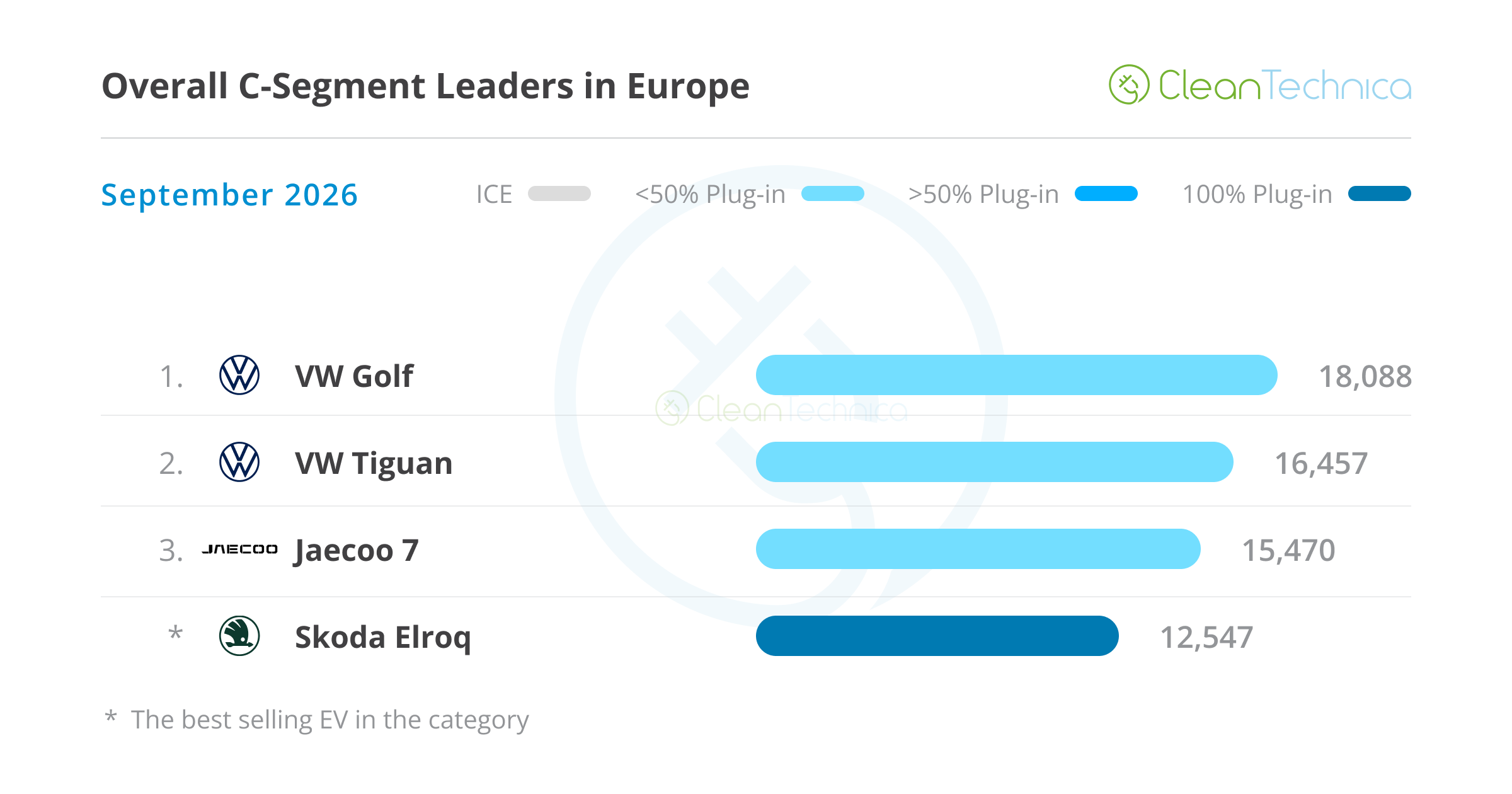
The B-segment remains a conspicuous weak spot: none of its three leading models had a plug-in version. The C-segment looks further along, with plug-in hybrids making up 31% of Volkswagen Golf sales, 32% of Tiguan sales and 47% of Jaecoo 7 sales.
Electrified powertrains also have a substantial presence in the larger categories. The BMW 5 Series, including the i5, drew 74% of its sales from BEV and plug-in hybrid versions. The source reports 28% electrification for the BMW X5 and says plug-in hybrids represented 33% of Range Rover Sport sales.
These larger models make for striking examples, but they sit in a relatively small part of the European market. The top-selling E-segment model ranked only 109th overall. Full-size vehicles represent 6% of the European market, compared with 18% in China and the United States. That gap puts a limit on how much premium large-car success can tell us about the direction of the wider market.
The overall pattern is more instructive: electrification is already pronounced in the D-segment, gathering pace in A, C and E, and lagging in B. That missing middle matters. Small and compact cars are central to broadening the range of affordable electric choices, while larger vehicles tend to serve a narrower audience.




Tesla takes the top two places
Tesla claimed first and second among September’s EVs, and the Model Y and Model 3 also finished first and second across the entire European market. It was only the second time the company had managed that overall one-two result; the previous occasion was December 2022. BYD put two models in the EV top five as well, underlining how the month’s leading positions are no longer a Tesla-only story.

The Model Y recorded 41,987 registrations, a 52% annual increase and its strongest monthly result in four and a half years. Built in Berlin, it topped the overall market in Germany, France, Iceland, Ireland, Sweden, the Netherlands, Norway, Switzerland, Denmark and Finland. Its September total was the second highest the model has recorded in Europe, behind 46,512 in March 2023.
With prices starting at €40,000, the Model Y is competing in a part of the market where buyers can weigh it against a growing set of midsize electric options. The list includes the Model 3, Xpeng G6, Mazda 6e and CX-6e, Deepal S07, BYD Seal and Seal U, Leapmotor C10 and Zeekr 7 GT. Many German-brand alternatives start above €50,000, leaving a price gap that gives less expensive electric models room to appeal.
That positioning is a practical strength. A buyer who prioritizes the price, running costs and available equipment may see a compelling case in a well-priced BEV, even without choosing a model for its badge. The Model Y’s continued success after six years on sale suggests that its appeal is tied to the whole package, not simply the arrival of a new model year. The registration figures don’t establish the ownership costs each driver will face, but they show that competitive prices and ready supply can turn broad interest into substantial volume.
The Model 3 followed with 26,770 registrations, up 120% year over year. Starting at around €35,000, the midsize sedan is priced close to some compact hatchbacks, which broadens its potential comparison set. The source reports a three-to-four-month waiting list as demand outstrips the pace of deliveries.
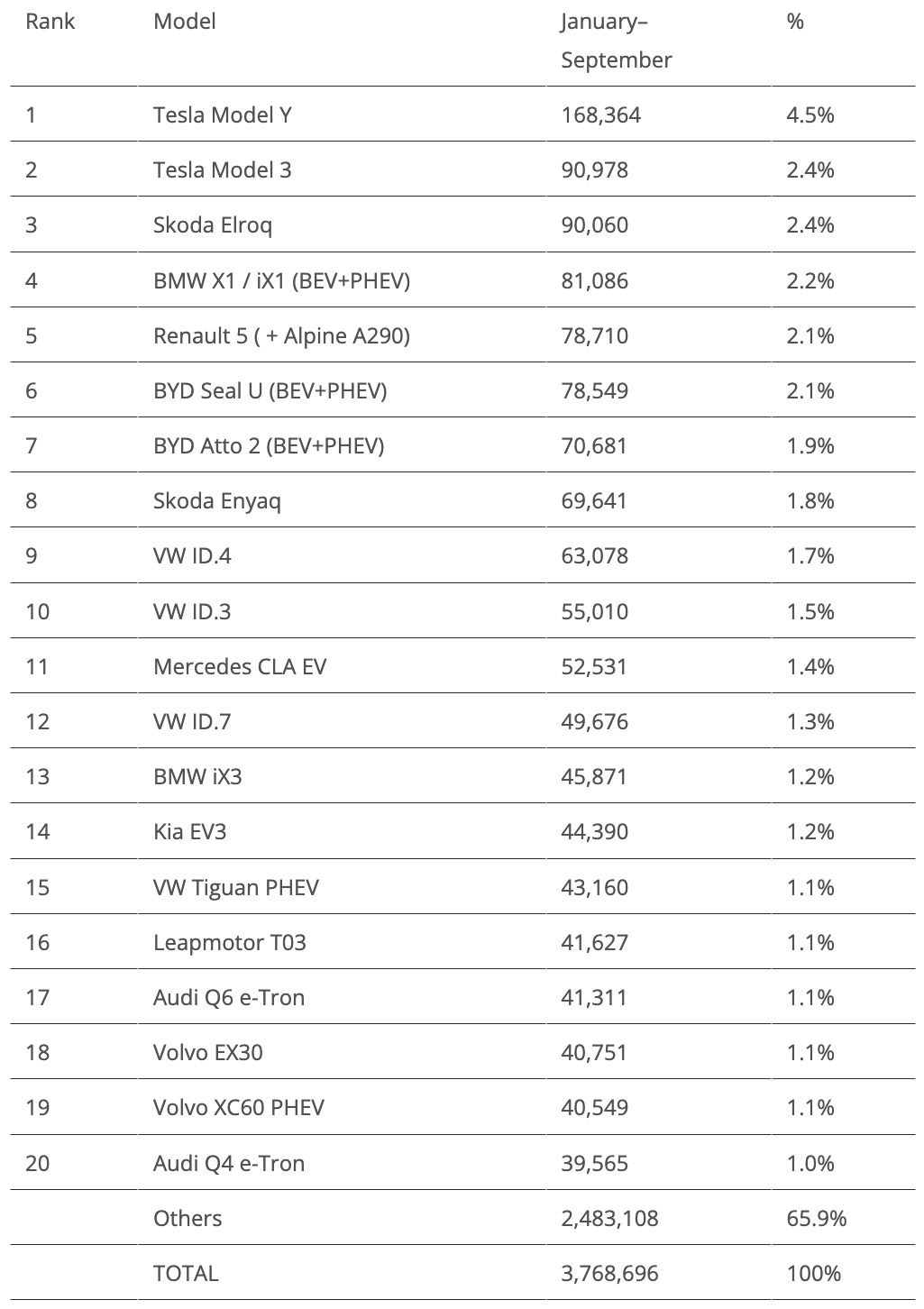
That’s a notable showing for a model launched a decade ago and for a sedan in a market where that body style has limited popularity. Its September volume lifted it to second overall for the month. In the year-to-date model ranking, it jumped four places to second, overtaking the Skoda Elroq despite the Elroq also posting a monthly record. A podium finish for the Model 3 is now assured, and it has become a strong contender for the year’s runner-up position.
September’s five leading EVs
Third place went to the BYD Seal U, counting both BEV and plug-in hybrid versions. It set a record with 12,779 registrations. Discounts helped lift sales, and with the model’s development costs already behind it, BYD has room to use pricing to compete. The result also shows how a model can keep drawing buyers in Europe even as the manufacturer’s attention at home shifts to newer products.
The Skoda Elroq placed fourth on 12,592 registrations, also a record. Its next challenge comes from within Skoda’s own range: the smaller, less expensive Epiq is nearing launch. If it arrives with competitive pricing and features, the question will be whether it brings in new customers or takes some of the Elroq’s sales.
Fifth was the BYD Atto 2, combining BEV and plug-in hybrid versions, with 11,111 registrations. The plug-in hybrid accounted for much of its performance. In its top-range form, the model has an 18 kWh battery and a stated usable electric range of 90 km (56 miles), along with vehicle-to-load capability. Those features make it a particularly strong fit for the small plug-in hybrid category, where the source reports few direct competitors. The related Dolphin G plug-in hybrid hatchback, which is to be built in Hungary, could give BYD another model in the European rankings.

Record volumes reach more brands
The results below the top five show that the surge is spreading across different vehicle types and price points. Mercedes recorded its best months to date for both the CLA EV, in 15th place with 7,206 registrations, and the new GLC EV, in 16th with 7,099.
The GLC’s production pace is a point to watch against the BMW iX3. The GLC’s reported waiting time is five to six months, compared with about nine months for the BMW. Mercedes is running its Bremen factory six days a week, around the clock, to build the GLC. BMW has only recently added a second shift at its Debrecen plant. Waiting times don’t measure total output by themselves, but these figures suggest Mercedes may be bringing its new electric SUV to customers more quickly.
Kia’s EV3 reached a record 7,385 registrations to finish 11th. The newer EV2 small crossover, which has a high-riding hatchback profile, set another record at 6,458. It is still in production ramp-up and has a substantial waiting list, making it a candidate to become Kia’s best-selling model in Europe.

Renault’s Twingo reached 10th with 7,776 registrations, its best result so far. The monthly figure prompts a straightforward test for its next stage: whether the small electric car can reach 10,000 registrations in a month. Volvo’s EX30 also returned to a stronger result. Despite battery-related constraints affecting production of the EX60, the smaller crossover reached 7,245 registrations, its best monthly performance in two years.
Chinese brands placed five models in the top 20. In addition to the BYD Seal U, the Jaecoo 7 plug-in hybrid took 13th with 7,262 registrations, the Geely Starray plug-in hybrid finished 17th on 6,888, and the Leapmotor B10 reached 19th with 6,262. All three are compact crossovers. Their results add to the BYD presence in the top five and show that Chinese automakers’ European growth is spread across more than one brand.
Several more models outside the top 20 set new records. BYD logged 4,545 Seal registrations, 5,413 for the Sealion 07, 3,813 for the Dolphin G and 3,347 for the Atto 3. Volkswagen Group set records with the Audi A3 plug-in hybrid, Golf plug-in hybrid and ID.Buzz. Production of the Cupra Raval and Volkswagen ID.Polo continued to build, reaching 4,746 and 2,572 units respectively.
Kia’s additional records included 3,607 EV5s and 2,309 PV5s. Geely’s E5, known as the EX5 in some markets, registered 2,936 units, while the E2, a European-specification version of the Xingyuan, reached 1,383 in its first full sales month. Toyota also set records with the C-HR+ and RAV4 plug-in hybrid. Nissan’s Micra, which shares its underpinnings with the Renault 5, recorded 2,510 units.
The year-to-date race tightens
September reshaped the 2026 model table. The Model 3’s jump to second place was the biggest change. It had to overcome a gap of more than 13,000 units to move past the Skoda Elroq, which itself had just set a record. That makes the sedan’s position particularly striking: its rise came during an exceptional month, but it has now built enough of a lead to secure a place on the annual podium.
The Renault 5 faces a more difficult fight to keep its position ahead of the BYD Seal U. Its margin over the Atto 2 gives Renault more breathing room there, but the Seal U’s growth is a closer concern. Production may become part of the contest. The Renault 5 shares its factory line with the Renault 4, Nissan Micra, Scenic and Megane, limiting the scope to increase its output quickly.
The Skoda Enyaq moved up one place to eighth, overtaking the Volkswagen ID.4, which is nearing the end of its run. Volkswagen’s forthcoming ID.Tiguan will be measured against a demanding benchmark: the ID.4 previously finished third overall twice, in 2022 and 2023.
Further down the table, Kia’s record month lifted the EV3 by two places to 14th. The Audi Q6 e-tron and Volvo EX30 moved ahead of the Audi Q4 e-tron and Volvo XC60 plug-in hybrid, respectively, after weaker September results for those models.
The Mercedes CLA EV has also become a substantial part of the annual picture. It had passed 52,000 units with three months still to go. The CLA nameplate historically sold 65,000 to 70,000 units a year in a strong year across its versions, so the electric variant is approaching a level that would once have been notable for the whole model line. Its electric station wagon version adds a body style unavailable in the A- and C-Class ranges. The CLA is also described as highly energy-efficient, which helps it offer above-average range with batteries of average size.

Brand results show very different positions
Tesla was seventh among brands, up 71% year over year, while Ford ranked 16th and was down 18%. The Model Y and Model 3 could dominate the monthly model table without giving Tesla the same standing in the brand rankings: the company has a narrower lineup than manufacturers represented across many segments and powertrains.
Ford’s European position reflects a different challenge. The discontinuation of the Fiesta and Focus has left the company without two long-running small-car nameplates. Its current range includes the seven-year-old Puma, the Kuga, two Volkswagen-based models and van-based people carriers. Future small electric models based on Renault platforms could give Ford a new way to compete, but the September numbers don’t yet show that renewed momentum.
BYD finished 11th among brands with 49,340 registrations, up 102% year over year, ahead of Dacia in 12th and MG in 13th. Its growth also illustrates the depth of Chinese competition: 15 Chinese brands made Europe’s top 50. Jaecoo ranked 22nd, up 157%; Omoda was 27th, up 111%; Leapmotor reached 28th, up 324%; and Chery stood 29th, up 688%.
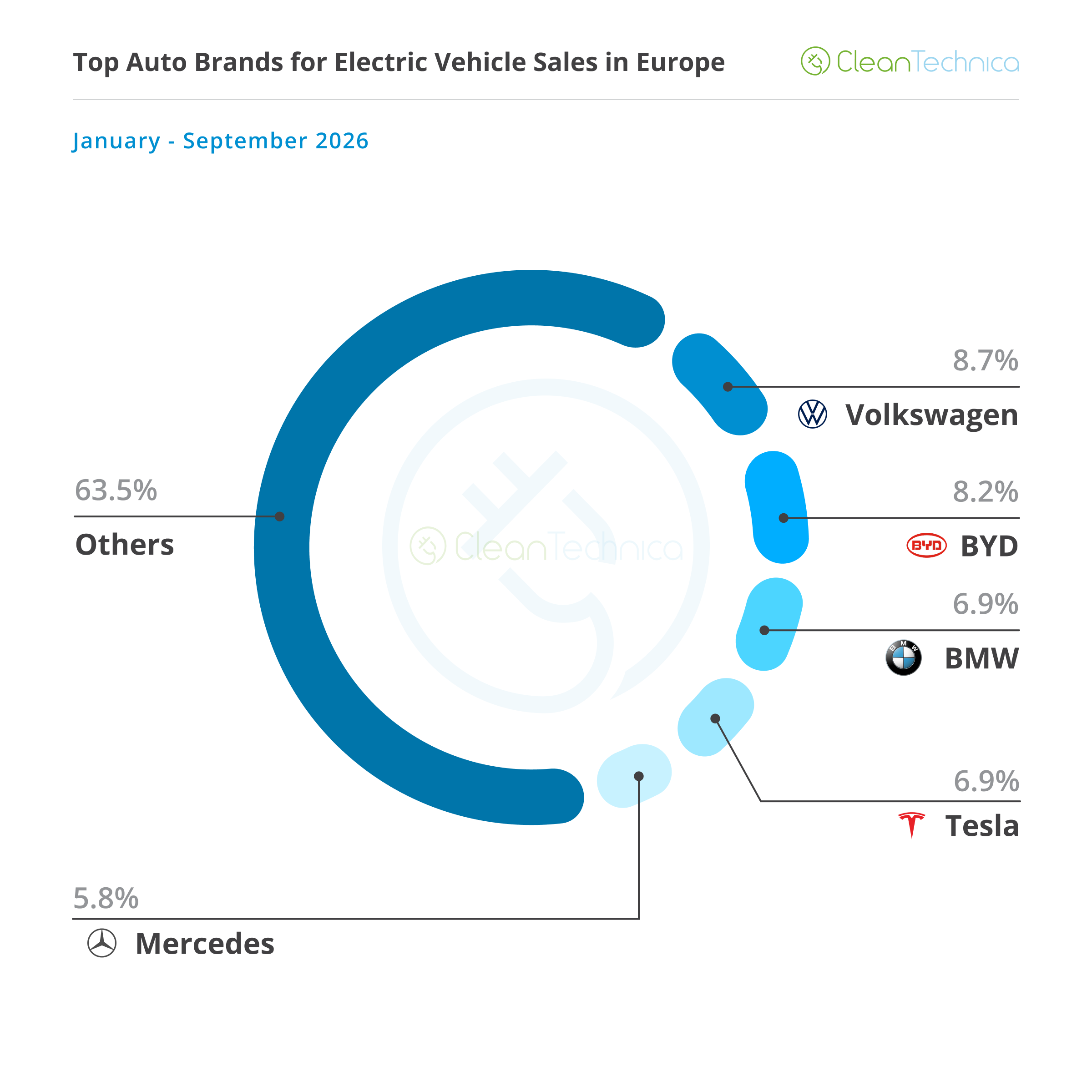
Among plug-in brands, Volkswagen remained first, but its share slipped to 8.7% from 8.9% in August and 9.3% in May. BYD was closing in at 8.2%, having gained 0.2 percentage points. New Volkswagen Group electric models, including the ID.Polo, ID.Cross and ID.Tiguan, could help lift its volume, but the brand will need to keep deliveries growing as BYD adds products and gains ground.
BMW held third with a 6.9% share, down 0.3 points. Tesla was also at 6.9%, up from 6% in August, and ended September only 100 units behind BMW. Tesla’s late-quarter delivery pattern helped its result, while BMW needs more models to add volume. The iX3 alone may not be enough to maintain the lead; the new i3 sedan will need to ramp up quickly and contribute substantial deliveries in the fourth quarter.
Mercedes held fifth with 5.8%, ahead of Audi at 5.3% and Skoda at 5.2%.
BYD gains as group rankings shift
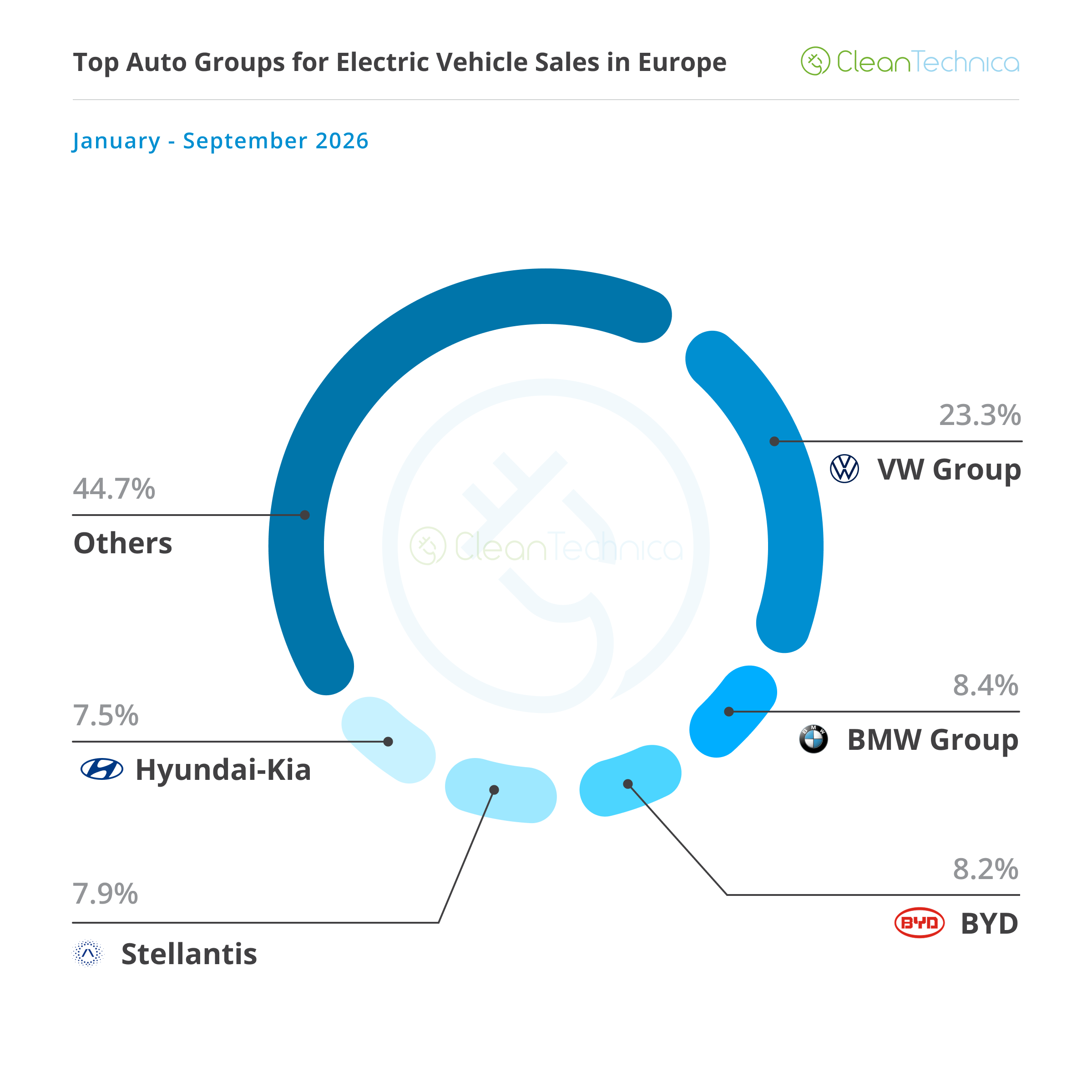
Volkswagen Group remained the leading automotive group, although its share fell from 23.9% in August to 23.3%. The lead remains sizeable, but the coming wave of new models will have to meet expectations if the group is to keep its position secure in 2027.
BMW Group was second at 8.4%, down 0.3 points. BYD rose to 8.2%, up 0.2 points, leaving only 0.2 points between them. BYD’s broad lineup and quick volume growth put it in range of the group runner-up position. Its longer-term reach will depend on how effectively it converts that product breadth into sustained deliveries across Europe.
Stellantis ranked fourth at 7.9%, down 0.2 points. Despite the record month across the market, none of its models posted a record result. The group has many vehicles capable of selling a few thousand units a month, but lacks a clear volume leader. The next Peugeot 208 will carry particular weight if it is to change that pattern.
Geely reached 6.9%, up from 6.8% in August, while Hyundai–Kia held 7.5%. Tesla, at 5.9%, is close enough to make the contest for sixth place worth watching.
Demand ran ahead of some production plans
The September surge arrived after a year that had started with more moderate growth expectations for electric cars. The figures show that several manufacturers had to contend with longer waits, limited battery supply or factories that could not quickly add output. At the same time, Tesla and Chinese brands were well placed to serve buyers looking for electric cars that were available sooner.
The account links the sudden change in buying interest to higher fuel prices after oil prices surged following attacks on Iran by the United States and Israel on February 28, 2026. Some customers appear to have approached an EV purchase as a way to reduce their fuel costs. That kind of buyer may give greater weight to price and delivery timing than to brand history or body style.
Chinese manufacturers also had a reason to direct more vehicles to export markets: demand in their home market had weakened toward the end of 2025. For Europe, that meant additional supply from brands already expanding their presence. Tesla had its own advantage in competitively priced products and a production structure that could scale quickly. The available numbers don’t quantify how much of the September increase came from fuel prices, new models or supply, but they show several pressures converging at once.
For buyers, the immediate practical constraint is availability. Some popular models now have waiting lists of several months, while vehicles already in stock can be easier to obtain. For manufacturers, the challenge is to match a fast-changing order book with battery supply, factory capacity and a product mix that no longer looks as combustion-heavy as some plans assumed.
Some established brands are responding faster
Kia, Toyota and Renault were among the strongest large manufacturers in September, with year-over-year growth of 110%, 94% and 73%, respectively.
Kia’s expanding electric range gives it several entry points, from the EV2 and EV3 through the EV4, EV5, EV6 and EV9, plus the PV5. Most are comparatively recent, and the company makes vehicles in South Korea and Europe. The EV3 and EV2’s record registrations show that the newer small and compact models are contributing alongside Kia’s longer-running offerings.
Toyota’s long-standing customer base may help buyers consider a BEV when a suitable product arrives. The C-HR+, Urban Cruiser and new RAV4 plug-in hybrid came at a time when demand was growing, and each has helped broaden the company’s electrified range. Toyota’s September result also highlights the value of timing: a brand can benefit when new models reach showrooms just as more customers are ready to switch.
Renault entered the demand surge with a small electric car that had already established itself. The Renault 5 had found buyers before September’s exceptional growth, and the Twingo is now recording its own strong results. The Renault 4 has not matched the 5’s sales success, but the Twingo’s early performance extends the brand’s opportunity into a smaller category.
Renault still faces production limits. The R5, Megane and Scenic share the Douai factory with the Nissan Micra, and the plant is already operating five days a week, around the clock. The resulting three-to-five-month waits are not unusual among sought-after electric cars, but the shared production line restricts how far output can rise. A stronger focus on the Slovenia-built Twingo and Dacia Spring could ease that pressure. Nissan’s 4,300 September registrations were its best in four years, giving the group another opportunity to use its existing nameplates to lift sales. The source also points to plans to build Alpine into a more credible premium brand.
Stellantis has products, but supply and demand remain challenges
Stellantis grew 53% year over year, yet its group share declined. The issue described is twofold: the company needs stronger demand for its electric models, and its battery orders were based on a sales mix that assumed more combustion vehicles than buyers ultimately chose. When BEV demand rose and combustion demand fell, the group had production capacity but not enough batteries to use it fully.
The pressure shows up in delivery times. The Peugeot e-3008 had a reported wait of five to eight months, and the Opel Grandland EV about six months. Smaller models such as the Peugeot 208 EV and Opel Corsa EV use CATL batteries, which helped those cars avoid the same constraint, at a likely added cost. The older Peugeot 208 EV nevertheless reached 4,580 registrations in September, its best month since March 2024.
That result gives Stellantis a useful foothold, but many of its current electric models are no longer new to the market. It needs to secure batteries for its C- and D-segment vehicles and bring the next Peugeot 208 and 2008, Opel Corsa and Mokka, and possibly a Fiat Punto, to market quickly. The goal is to compete for buyers considering newer cars such as the Renault 5 and Volkswagen ID.Polo.
Production delays and aging products weigh on others
Ford grew just 3% year over year, Volvo 4%, Hyundai was flat, Volkswagen Group rose 19%, BMW 12% and Mercedes 15%. Those figures vary widely, but the underlying problems differ too: product gaps for some, factory limits for others and transitions between generations across several brands.
Volvo’s EX60 was meant to start a new growth phase, but reported problems involving its SPA3 platform, mega-casting production process and battery supply have slowed the ramp-up. The source puts 50,000 orders on hold and the waiting list at six to 12 months. That leaves the EX30 to support the brand while the roughly nine-year-old XC60 plug-in hybrid and EX40 continue to age. Resolving the EX60’s production issues will be central to Volvo’s recovery.
Hyundai’s flat result contrasts with Kia’s growth. The IONIQ 5 and IONIQ 6 attracted attention when they launched in 2021 and 2022, including for their 800-volt architecture, but the range has had fewer new additions since then. The Inster has not yet established a broad following. Its size and shape leave it between familiar categories, and its design may narrow its appeal. The upcoming IONIQ 3 could give Hyundai a fresh opportunity, but September’s numbers suggest it has work to do before that model arrives.
Volkswagen Group appears to be between waves of growth. Its MEB models have been stable or losing ground, while the smaller MEB+ vehicles—including the Cupra Raval, Skoda Epiq and Volkswagen ID.Polo—are still ramping up. Their waiting list is reported to be around ten months. The group chose to build MEB+ models in Spain for cost reasons, leaving some German plants running below capacity. That setup may help reduce production costs, but it does not make deliveries immediate while demand remains ahead of output.
BMW’s iX3 and i3 are positioned as high-priced products, and the iX3 has a reported six-month wait. Yet its production is described as steady at around 7,000 to 8,000 units, a respectable volume that may still fall short of what the demand surge could support. If i3 production reaches a similar pace, BMW may also find itself holding customers in a queue while its older models lose attention. Its production choices will help determine whether strong interest translates into a larger share of the market.
Mercedes’ new electric models have arrived in a faster sequence. The CLA, GLC and GLB have ramped up quickly and reached record registrations, with the GLA, VLE and electric C-Class expected to add more volume. Its 15% year-over-year growth was held back by the winding down of the EQA, previously a leading seller, and lower plug-in hybrid sales as the range shifts toward BEVs. The GLA’s wider rollout should help sustain deliveries, while the narrowing gap to BMW adds another competitive measure to watch.
The next test is delivery capacity
September’s record is more than a strong month for electric registrations. It exposes the differences between automakers that can respond quickly to a change in demand and those whose batteries, factories or product timing limit their ability to do so. Tesla and Chinese manufacturers benefited from competitively positioned models and available production. Renault, Kia and Toyota also arrived with products that met the moment, while other established brands are still waiting for new models or resolving supply constraints.
That doesn’t make a single month a verdict on any manufacturer’s long-term prospects. It does make the final months of 2026 a useful test of how quickly waiting lists can turn into deliveries. The models with the strongest immediate case are those that pair a price buyers can accept with a practical range, useful features and an attainable delivery date. September suggests that in Europe’s EV market, the ability to build and deliver the right car is now as decisive as having it on the product plan.