Latin America EV Sales Reach 220,000 in Q3 as Market Share Climbs to 12%
- Juan Diego Celemín Mojica
- 562 views
Latin America’s EV sales rose 140% year over year in Q3. Brazil and Colombia lead growth, while vehicle prices appear to matter more than fuel costs.

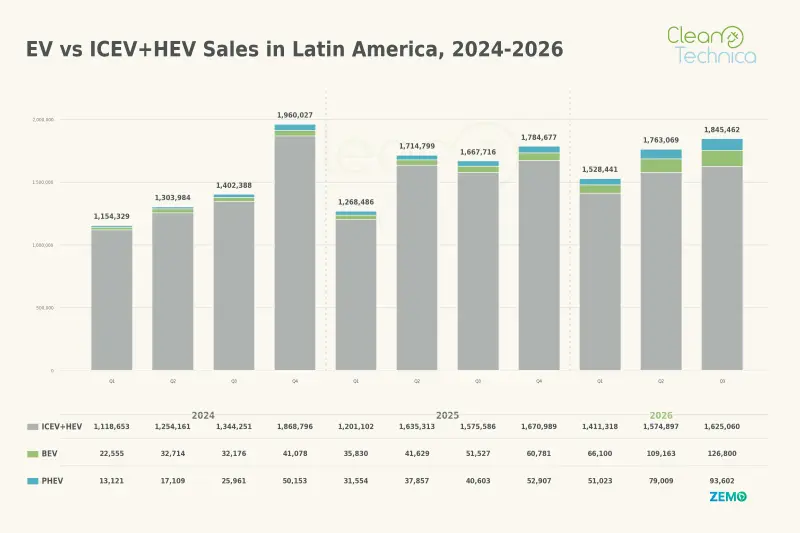
Electric vehicle sales in Latin America topped 200,000 for the first time in the third quarter of 2026, reaching 220,000 units. That’s a 140% increase from a year earlier and 17% above Q2. The region’s EV market share rose to 12%, a sharp jump from 5.5% in Q3 2025. The pace puts the region among the fastest-growing EV markets, even though its total vehicle market is about one-third the size of the United States’ and average incomes are lower.
The Q3 total was close to the US figure of 266,000 EVs. The mix differs: Latin America recorded 127,000 battery-electric vehicles (BEVs) and 93,000 plug-in hybrids (PHEVs), while the US had 242,000 BEVs and 44,000 PHEVs. BEVs grew faster than PHEVs in Latin America, up 146% year over year against 130%, but their share of regional EV sales edged down to 57.5% from 58% in Q2.
Growth is changing the market mix
EVs accounted for 10% of vehicle sales across the region through 2026, comprising 5.9% BEVs and 4.3% PHEVs. In Q3 alone, EV share reached 12%, compared with 10.7% in Q2. The broader vehicle market is growing around 10% annually, but sales of combustion vehicles and non-plug-in hybrids have been far less dynamic: that group fell 3.7% in Q2 and grew just 3.1% in Q3.


Brazil led EV sales by country, followed by Mexico and Colombia, the same top three as in Q2. Uruguay came next, while Ecuador stood out among the rising markets: it approached 5,000 BEV sales in the quarter. Costa Rica, Chile and Argentina completed the top eight, each with more than 1,000 quarterly BEV sales.
The PHEV rankings were more varied. Brazil remained first, followed by Mexico and Argentina. Colombia ranked fourth and Ecuador fifth. That split matters: a country’s EV growth can look different depending on whether buyers are choosing fully electric models or plug-in hybrids.
Uruguay led on EV market share, with 50.7% of vehicle sales in the quarter carrying a plug, including a 45.7% BEV share. Costa Rica, Colombia, Ecuador and Brazil followed. Paraguay also crossed the 10% EV share threshold for the first time, driven by PHEVs. Across the region, five leading markets have made substantial progress, but several large countries still have room to build consistent BEV adoption.


Sticker prices help explain the leaders
Higher fuel costs may help EVs compete, but the country-by-country results suggest they don’t explain the whole story. Gasoline prices rose by more than 50% in Panama and Peru, yet both markets remain comparatively small for EVs. Brazil and Colombia, by contrast, saw fuel prices rise around 10% or less while EV sales surged 160% and 190%, respectively. EV market share in those two countries is approaching 20%.
The stronger clue may be the purchase price gap between an EV and a combustion model. In Brazil and Colombia, combustion vehicles are relatively expensive, partly because tariffs protect local industry. EVs have reached price parity with comparable combustion models, making the upfront choice easier for buyers. Lower fuel costs can still shape ownership expenses, but a buyer first has to be able to afford the vehicle.
Panama and Peru present a different calculation. EVs can cost as much as, or less than, those in Brazil and Colombia, but combustion cars are significantly cheaper. Some entry-level models are priced at or below US$10,000. Even when an EV promises lower running costs, the upfront gap can leave buyers weighing that saving against a substantial amount of fuel.
Peru’s popularity of low-cost combustion cars from Chinese brands adds another wrinkle. Changan, Jetour, Geely and JAC together account for 20% of the Peruvian market, largely through affordable petrol models. As the domestic Chinese combustion market contracts, those brands may have reason to keep selling existing models in Peru before shifting their focus more heavily to EVs.
Fuel prices still count, but their effect appears limited beside the purchase-price comparison. That’s a useful lens for buyers and manufacturers alike: where EVs match combustion cars on price, adoption can accelerate even without a sharp rise in fuel costs. Where inexpensive petrol cars dominate, higher fuel bills alone may not be enough to shift demand quickly.
The next test is broader adoption
At the start of 2026, a 10% regional EV share in Q4 looked ambitious. Latin America passed that mark in Q2 and reached 12% in Q3. If the pace holds, annual sales could exceed 700,000 units and perhaps approach 800,000, against more than half a million recorded so far this year. Those are projections, not confirmed totals, and the final result will depend on whether current momentum continues.
The growth is striking, yet adoption remains uneven. Chile, Argentina and Mexico are among the large markets still lagging, and outside the leading five countries, consistent BEV market share above 5% remains elusive. PHEVs have helped lift the overall figures in several places, with Paraguay a notable example, but a higher BEV share would show that fully electric choices are reaching more buyers.
A 20% regional EV share is now a plausible milestone to watch, with Q3 2027 raised as a possible timeframe. Electric truck sales are another open question for 2027 or 2028. For now, the clearest signal is that Latin America’s transition is being shaped by what vehicles cost at the showroom as much as what drivers pay at the pump.