James Bond’s Best and Worst Cars, From the Aston Martin DB5 to the Lotus Esprit
- Matt Robinson
- 563 views
Bond’s car history runs from the gadget-packed DB5 to a humble Citroën 2CV. Here are the standout cars, misfires and villain rides.
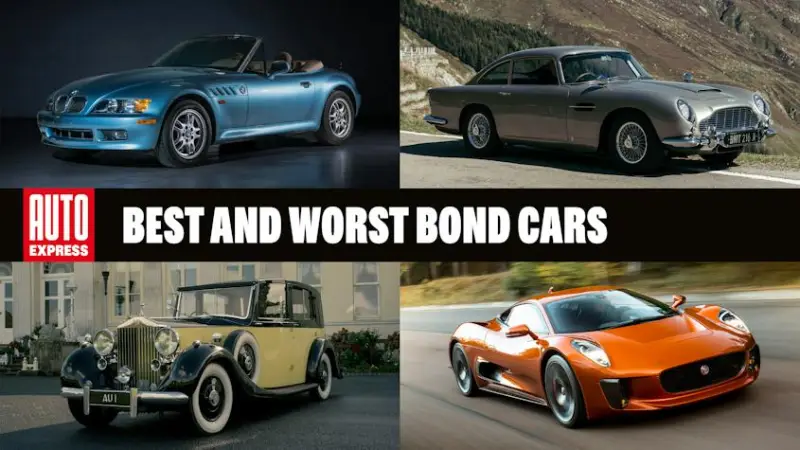
James Bond’s cars do more than get him from one chase to the next. The best become part of the character: the Aston Martin DB5 is practically a co-star, while the white Lotus Esprit is inseparable from Roger Moore’s 007. Others are remembered for a brief appearance, an over-the-top gadget or a spectacular exit.
That history raises a question for Bond 26: what should Robert Pattinson drive? He has been named as the next Bond, and an announcement video has shown him as 007. An Aston Martin remains a plausible choice. The brand’s chief executive, Adrian Hallmark, has spoken about the franchise’s importance in attracting customers to Aston Martin, and the company has good reason to seek a place for one of its newer models in the film.
There are several possibilities. The Valhalla will appear in virtual form in the game 007: First Light, though its striking looks may make it a conspicuous choice for a spy. The current Aston Martin Vanquish might fit more naturally, while a DB5 cameo would connect the new film to the franchise’s most familiar car. Another option is the next Lotus Type 135, expected to take the Esprit name. A new Esprit would revive a marque with a strong Bond legacy, though Aston Martin may prefer to keep 007 in one of its own cars.
The cars that made Bond history
Aston Martin DB5: the defining Bond car. No model has a stronger claim to being Bond’s signature car than the DB5. It debuted in Goldfinger, where Q, played by Desmond Llewelyn, equips it with the gadgets that helped establish the formula for Bond’s company cars.
In the film, Sean Connery’s 007 uses tyre-slashing wheel hubs against Tilly Masterson’s Ford Mustang, then follows Auric Goldfinger’s Rolls-Royce to a factory in Austria. The DB5’s memorable escape sequence brings bulletproof glass, a rear shield, oil and smoke dispensers, machine guns concealed behind the indicators and an ejector seat operated from the gearlever.
The car returned in Thunderball, and its screen presence helped raise the profile of Aston Martin. It has since appeared across several eras of the series: in a brief moment in Casino Royale, then in more prominent roles in Skyfall, Spectre and No Time to Die. GoldenEye even paired it with a Ferrari F355, an unlikely race that gave the classic Aston another turn in the spotlight.
Lotus Esprit: the submarine with a supporting cast. If another car can rival the DB5 as Bond’s most recognisable ride, it is the white Lotus Esprit from The Spy Who Loved Me. The car is closely associated with Moore’s years as 007, and its transformation into a submarine remains one of the series’ most memorable vehicle tricks.
Bond’s investigation into missing British, Russian and American submarines takes him to Sardinia, where Q has prepared the Esprit. Its equipment includes cement-spraying jets, a mine dispenser and missiles, but the feature that matters most comes during a pursuit. Bond drives off a short pier, then changes the car into a submarine and escapes beneath the water.
The vehicle used underwater, nicknamed Wet Nellie, was a submersible disguised with a fibreglass Esprit shell. The production did not have the budget to build a watertight Lotus, so the set-up used a wet submarine with louvres covering the windows. Two scuba divers, hidden aboard, provided its movement. The car’s fictional trick was more elaborate than its practical filming solution, but the result still made the Esprit a franchise landmark.
Aston Martin DB10: a film car with a production-car secret. Built specifically for Spectre, the DB10 was shaped through collaboration between Aston Martin design chief Marek Reichman and director Sam Mendes. It is one of the series’ most striking cars, even if the film initially assigns it to 009 before Bond takes it for a Rome chase and sends it into the Tiber.
Under its bespoke bodywork sat the basis of a next-generation Aston Martin Vantage, shown more than two years before the production model reached the public. Aston Martin built ten DB10s and kept two. One later sold to a private buyer for £2.4 million, above its £1.5 million estimate, despite not being road legal. The DB10’s appeal rests on more than screen time: it offered an early look at the design direction of a future road car.
Sunbeam Alpine: a modest start. The first Bond film, Dr No, had a budget of less than £1 million, so Connery did not get a gadget-laden Q Branch special. Bond instead drives a rented Sunbeam Alpine while pursuing Dr No in Jamaica. Its 1.6-litre engine produces 80bhp, and its mechanical underpinnings are shared with the Hillman Husky estate.
The Alpine has to outrun a LaSalle hearse driven by the Three Blind Mice, Dr No’s henchmen. Its handling and low height prove more useful than power: Bond slips beneath a crane blocking the road, while the hearse and its occupants go over a cliff. The production borrowed the Alpine from a local owner. In Ian Fleming’s novel, Bond’s car was a Hillman Minx saloon, an even less glamorous choice.
Aston Martin DBS: drama without gadgets. The 2006 relaunch of the series took Bond in a grittier direction, but kept Aston Martin in the lead. Daniel Craig drove a DBS in Casino Royale, a year before the model went on sale. Like George Lazenby’s DBS in On Her Majesty’s Secret Service, it carried no special equipment.
The film still gave the car a dramatic role. Bond swerves to avoid Vesper Lynd, played by Eva Green, who is lying in the road, and the DBS launches into a crash sequence that ends with seven consecutive barrel rolls. The stunt earned a place in the Guinness Book of Records, though the car’s extreme flight asks a lot of a viewer’s belief in physics. A DBS returned for the opening of Quantum of Solace, where it lost its doors and had its windscreen shattered during a chase.
Ford Mustang Mach 1: an escape with a continuity error. In Diamonds Are Forever, Bond joins diamond smuggler Tiffany Case, played by Jill St John, in her rented 1971 Ford Mustang Mach 1. After escaping a research facility in a moon buggy, the pair head for Las Vegas and attract police attention. Bond uses a car park to shake off several pursuers, then takes the Mustang into a narrow alley on two wheels.
The stunt is better remembered for a continuity slip than for the escape itself. The Mustang enters the alley balanced on its right tyres, but emerges balanced on its left. It is a small mistake, yet one that has become a favourite example of the series’ occasional on-screen oddities.
BMW Z8: a strong car, a destructive exit. BMW’s final Bond car was a stylish Z8 roadster driven by Pierce Brosnan. Q’s new assistant, R, played by John Cleese, introduces Bond to a remote-control key fob and titanium armour. The most dramatic equipment is a pair of surface-to-air missiles hidden behind vents in the front wings.
The Z8 is eventually cut in half by a circular saw suspended from a helicopter belonging to Elektra King. The roadster had not yet launched when the film came out, so the on-screen car was a mock-up using a Corvette engine and a kit-car chassis. No production Z8s were damaged for the scene. After the less memorable Z3 and the more restrained 750iL, the Z8 gave BMW’s run in the series a better-looking finish.
Citroën 2CV: a small car in a big chase. Bond cannot always count on a supercar or Q’s equipment. In For Your Eyes Only, Moore and Melina Havelock, played by Carole Bouquet, flee down a Spanish hillside in a yellow Citroën 2CV. Two more powerful Peugeot 504s chase them, but the 2CV’s route through rough terrain keeps the pursuit lively.
For the stunts, driver Rémy Julienne replaced the standard car’s 602cc two-cylinder engine with a more powerful four-cylinder unit from the Citroën GS. The film also inspired a roadgoing special finished in the same yellow, with 007 markings and imitation bullet holes. It has since become a sought-after version among 2CV enthusiasts.
Bond’s less convincing rides
Aston Martin Vanquish: the invisible-car problem. The Vanquish in Die Another Day had the expected weapons and a strong Aston Martin badge on its bonnet. Its ability to turn invisible, though, pushed the car well beyond even the series’ usual tolerance for extravagant gadgets. The model choice worked; the trick was harder to take seriously.
Ford Mondeo: a short-lived brand placement. In Casino Royale, Craig’s Bond also drives a Ford Mondeo. The car reflects the commercial arrangement behind the film, but its brief appearance sits awkwardly beside the DBS. It is a reminder that placing a mainstream model in a spy thriller can draw attention to the deal as much as to the vehicle.
BMW Z3: barely on screen. BMW’s first Bond car appeared in GoldenEye, but the Z3 gets less than two minutes of screen time. Q says it has “all the usual refinements”, including stinger missiles, yet viewers see little of the car or its equipment. The BMW deal arrived late in production, which helps explain the limited role. As a marketing exercise, the tie-up was widely regarded as highly successful; as a Bond car, the Z3 never had much opportunity to make an impression.
The vehicles driven by Bond’s opponents
Bond’s rivals have their own memorable machines, and a few have become as visually distinctive as 007’s cars. In No Time to Die, two Range Rover Sports chase Bond before a pair of new Land Rover Defenders join the action, launching through the air during the sequence. The scene gave the Defender a starring stunt role alongside the Range Rover Sport.
Jaguar C-X75: a concept car built for a chase. The C-X75 was cancelled amid the difficult economic conditions of the early 2010s, but Spectre put a version of it on Rome’s streets opposite Bond’s DB10. The car driven by Dave Bautista was built around a bespoke space frame and styled to resemble the Jaguar, rather than being a production C-X75. The original concept used diesel-fed turbines to charge a battery pack that powered several motors; the filming car instead used a V8.
Rolls-Royce Phantom III: Goldfinger’s gold carrier. Auric Goldfinger’s Phantom III matches its owner’s taste for yellow: he wears the colour in every scene, and the V12-powered Rolls-Royce is painted to match. Its size and strength make it a suitable vehicle for carrying large quantities of gold around Europe. Goldfinger leaves the driving to his bowler-hatted henchman Oddjob.
Jaguar XKR: a heavily armed rival. Zao, the metal-faced villain in Die Another Day, gets a Jaguar XKR painted in the shade used by Jaguar’s racing team at the time. It carries a gatling gun, rockets and missiles, but still loses its contest with Bond’s Vanquish. The chase sets up an odd contest: the XKR’s weaponry is formidable, while the Aston’s most outlandish advantage is its invisibility.
Honda CRF250R: an even match on two wheels. Skyfall stages a chase using two Honda CRF250R motorcycles, ridden by Bond and the henchman Patrice. Putting both riders on the same machine makes the sequence feel like a contest of skill and control rather than a simple clash between differently equipped vehicles. It is a strong reminder that Bond scenes do not need a bespoke supercar to make a chase memorable.
For Bond 26, the car that makes sense will need to do more than carry a familiar badge. The series’ best vehicles have a clear role in the story, whether that means showcasing gadgets, revealing a future design or turning an ordinary car into an unlikely escape tool. An Aston Martin still looks like the safest bet for Bond’s garage, but a new Esprit would give the next film a recognisable piece of its own history.


