Best Electric Pick-up Trucks for 2026: Range, Payload and Towing Compared
- Matt Robinson
- 317 views
The UK’s electric pick-ups trade range and price for work-ready capability. Here’s how the D-Max EV, Hilux BEV and rivals compare.
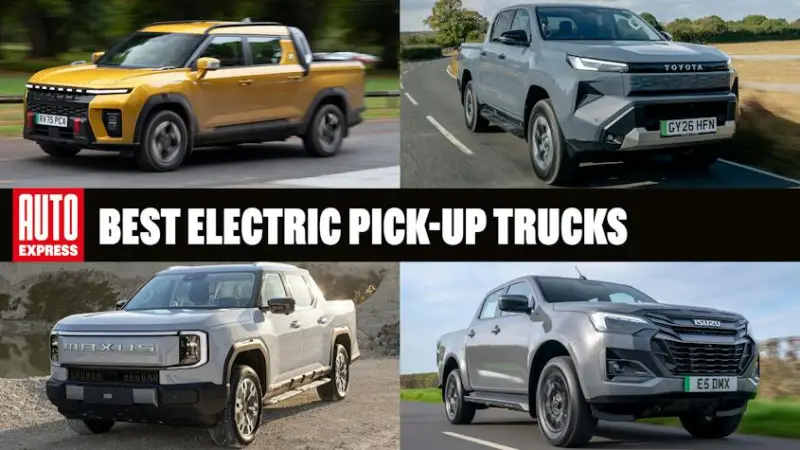
Electric pick-ups remain a narrow choice for UK buyers, and the trade-offs are clear: short driving ranges and high prices in exchange for quieter running and, in some cases, strong working capabilities. The Isuzu D-Max EV leads on payload and matches its diesel sibling for towing, while the KGM Musso EV stands out for range and price. Each suits a different job, so the right choice depends on what the truck needs to carry, tow and cover between charges.
For operators who can charge at base and work within a predictable daily radius, a battery pick-up may fit. For drivers who routinely travel long distances or need to tow heavy loads far from charging, the limitations matter more. Plug-in hybrids offer a middle ground, though the UK choice is currently limited to two models.
Isuzu D-Max EV: the strongest work credentials
The D-Max EV makes the clearest case for an electric pick-up as a commercial tool. Isuzu reworked the suspension to handle the battery’s weight and retain a useful payload: 1,060kg for the Extended Cab and 1,015kg for the Double Cab. That puts both versions above the 1,000kg threshold cited for commercial vehicle status, a distinction that brings VAT and Capital Allowances advantages.
No other electric pick-up in this group reaches that payload level; the next closest is hundreds of kilograms behind. The Isuzu can also tow up to 3,500kg with a braked trailer, matching the diesel D-Max. The Maxus eTerron9 matches that towing figure, but has a much lower payload.
Replacing the diesel engine also makes the D-Max a more relaxing drive, and the ride is described as comfortable. The catch is the price and the distance between charges. It costs around £20,000 more than the diesel version, has a stated range of 163 miles and tops out at 50kW charging. A 20–80 per cent recharge takes an hour, which limits flexibility on longer working days. For a business that values payload and towing above range, those compromises may be acceptable; for others, the premium will be hard to justify.
Toyota Hilux BEV: quicker charging, modest towing
The Toyota Hilux BEV gives up around 300kg of payload compared with the D-Max EV, but it remains an appealing choice for drivers who want a capable road vehicle with serious off-road ability. Its 56.2kWh battery feeds two motors, one at each axle. Toyota’s Multi-Terrain System adjusts motor responses to replicate the effects of a locking differential and low-range gearbox.
Range is a stated 150 miles, slightly below the Isuzu’s figure. The Toyota’s advantage is charging speed: its maximum rate of 150kW is three times the D-Max’s, which can make a substantial difference when a top-up is needed. It also edges the Isuzu to 62mph, taking 9.9 seconds, two tenths quicker. For most pick-up work, acceleration is a footnote. Towing capacity is more consequential, and at 1,600kg the Hilux falls well short of the D-Max.
KGM Musso EV: range and price take priority
The Musso EV was designed around electric power rather than adapted from a combustion model. Its 80.6kWh battery gives it a stated range of up to 249 miles; a real-world figure of about 200 miles is a more useful expectation. That puts it ahead of the D-Max and Hilux for distance between charges, though actual range will depend on use.
Its payload is 690kg, a clear step down from the Isuzu, while the 2,300kg towing limit beats the Toyota’s. The Musso EV’s strongest practical argument may be its price: it’s described as the cheapest electric pick-up on sale. For buyers who need more range than the Isuzu or Toyota can offer, and can work with a lower payload, that could make it the most accessible option.
Maxus eTerron9: power and storage, with compromises
The Maxus eTerron9 pairs a 102kWh battery with a stated range of 269 miles, the best figure among the UK options covered here. Its 436bhp also makes it the most powerful, though that output won’t be a priority for every work truck buyer.
Payload is the weak point at 620kg, the lowest in this group. Towing capacity is more impressive at 3,500kg, level with the Isuzu. The eTerron9 also has a 236-litre weatherproof front storage compartment and vehicle-to-load capability, which lets it supply power to equipment. Its maximum charging rate of 115kW is middling, and its ride and handling are poor. Add a high price and its appeal narrows to buyers who value its range, towing and extra storage enough to accept the compromises.
Plug-in hybrids: a short electric commute, then more flexibility
For drivers who want to cover some journeys on electricity but can’t make a short-range battery truck work, plug-in hybrids are worth considering. The UK choice currently comprises the Ford Ranger PHEV and the BYD Shark.
The Ranger PHEV uses an 11.8kWh battery for up to 26 miles of electric-only driving. Its 1,049kg payload is far more useful for work than the BYD’s and sits above the stated 1,000kg threshold for commercial vehicle status. The Ranger is also named 2026 Pick-up of the Year.
The BYD Shark costs more than the Ranger and carries 750kg, so it doesn’t qualify as a commercial vehicle on the stated payload threshold. Its advantages are performance and electric-only distance: the hybrid system produces 435bhp, with 0–62mph in 5.7 seconds, and the claimed electric range reaches 55 miles. Those figures may appeal to buyers who value a longer electric commute and brisk acceleration, while the Ranger looks better suited to heavier loads.
Electric trucks beyond the UK
Buyers in the US have a wider choice, including models that aren’t expected to reach the UK through regular sales. The Rivian R1T is a striking design and, in quad-motor form, accelerates from 0–62mph in 2.5 seconds. Payload can approach a tonne depending on specification. A handful have reached the UK through unofficial imports, but there’s no expectation of a full UK launch.
The Tesla Cybertruck has had a more difficult run. Despite its distinctive styling and brisk performance, quality problems and slow sales have weighed on the model. In November 2026, Tesla CEO Elon Musk said production would be wound down, after only three years on sale. The project’s reported $2 billion investment is unlikely to be recovered in full.
Ford has also stopped the F-150 Lightning programme after sales fell short. The electric truck offered 563bhp from a dual-motor setup, a 0–62mph time of 4.5 seconds and payload capacity of up to 800kg. Its 408-litre front storage compartment was another practical feature, but the model’s difficulties underline how challenging it remains to sell electric pick-ups at scale, even in a market with strong truck demand.
One future possibility is the Scout Terra, from Volkswagen Group subsidiary Scout Motors. Due in 2027 with a starting price of $60,000, it will share development costs with the related Scout Traveller SUV. Its retro styling is intended to give it a distinctive place alongside models such as the Rivian R1T.
For UK buyers today, the decision starts with the work. The D-Max EV is the standout for payload and towing, the Musso EV offers the most range for the money, and the Hilux trades range and towing capacity for quicker charging and off-road ability. The eTerron9 has the longest stated range and strongest towing credentials, but its price and low payload complicate the case. Where those battery limits don’t fit, the Ranger PHEV offers the strongest mix of electric running and load capacity.


