BMW iX3 Leads UK Hands-Free Driving Test as Rivals Struggle on Country Roads
- Phil McNamara
- 628 views
A seven-car UK test found the BMW iX3 easiest to use, while the Ford Puma Gen-E excelled on motorways and several rivals faltered on bends.
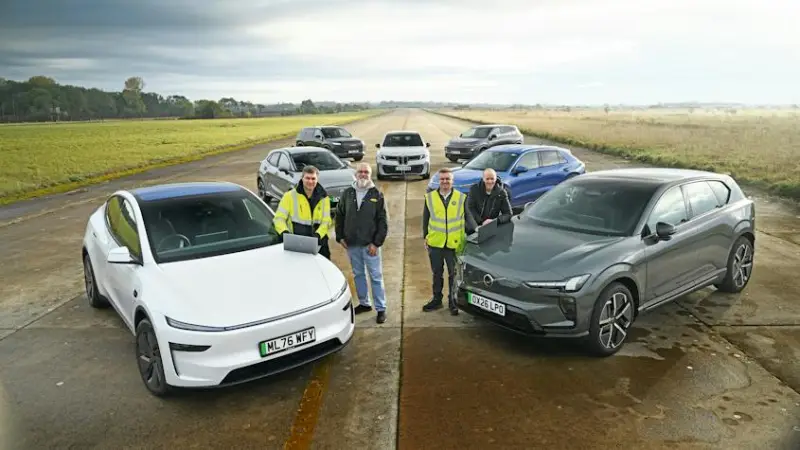
The BMW iX3 came out on top in a seven-car comparison of driver assistance systems, thanks to clear controls, reliable speed limit responses and steering that worked with the driver. The test also exposed a sharp divide between motorway performance and behaviour on rural roads: several cars managed steady highway cruising but struggled with bends, junctions or lane markings.
Every car in the group offers Level 2 assistance. That means each can monitor its surroundings, manage speed and distance behind traffic, and help keep the car in its lane. The Ford Puma Gen-E goes further with BlueCruise, a Level 2+ system that allows hands-free driving on designated UK motorways. The Tesla Model Y and Volvo EX60 can also change lanes automatically, though the driver must initiate or supervise the manoeuvre.
None of these systems makes a car autonomous. Drivers remain responsible and need to stay engaged. That distinction mattered throughout the test: when assistance dropped out, misread a corner or reacted late, the person at the wheel had to take over.
A varied route puts the systems under pressure
The 37-mile loop began at Upper Heyford and included about 10 miles on the M40, another 10 miles on the A422, and the A43 dual carriageway on the return. The route also passed through Middleton Cheney, Farthinghoe and Brackley. Its mix of motorway, sweeping bends, lower speed limits and roundabouts tested how well each system adapted to changing road conditions.
The cars were assessed on their responses to speed signs and road features, the ease of operating their controls, and how clearly they told the driver what they were doing. The aim was to minimise steering and speed inputs while keeping feet off the pedals wherever conditions allowed. No car in the group offered the kind of urban assistance that would take over more of the driving in built-up areas; BMW has said it aims to introduce that capability from 2027.
Seven models took part: the Jaecoo 7, Leapmotor B10, Ford Puma Gen-E, Volvo EX60, Tesla Model Y, Volkswagen T-Roc and BMW iX3. Their performances suggest that assisted driving still depends heavily on where it is used. A system that feels settled on a straight motorway may be far less convincing when the road narrows, curves or approaches a junction.
Jaecoo 7: too many warnings, too little confidence
The Jaecoo 7 was the least convincing car on the route. On a rural road with a 50mph limit, it approached a marked right-hand bend without turning sufficiently, leaving the driver to steer it through. At the next, tighter left, it moved close to the verge, then crossed towards the centre lines and corrected back towards the edge of the road. The driver had to intervene in both cases.
The warnings added to the workload. Over the 60-minute loop, the car issued 30 messages saying adaptive cruise control had been turned off and 28 alerts about driver distraction. That is roughly one of each every minute. A glance at the speed display was enough to prompt a distraction warning, even as the driver was checking how fast the car was travelling.
The test team also found the system’s controls and status displays hard to interpret. A long press on the steering wheel graphic activates lane assistance, while messages use a different abbreviation for the cruise function. The display’s small icons were difficult to see, and it was not always clear when speed assistance could be used. Adjusting to a new speed limit often meant changing the set speed manually.
The car’s responses to junctions and bends were inconsistent. On a rural B-road it approached a challenging 35mph corner at 55mph, requiring the driver to slow and steer. Elsewhere, it began to handle a gentle bend before abandoning the turn. At a roundabout, it slowed behind a vehicle ahead, but accelerated towards the central island after that vehicle left the approach. The driver again had to steer into the exit.
On the M40, the Jaecoo was more composed. It followed a lorry at a safe distance for about four minutes, but switched off steering assistance during lane changes and expected the driver to re-centre the car before it resumed. On the A43, it braked late for some roundabouts and repeatedly asked the driver to take over.
Jaecoo said its Intelligent Cruise Assist is calibrated for motorways and dual carriageways when conditions are suitable. The company said the system is not intended to replace driver judgement or operate autonomously, and is designed to deactivate outside its intended conditions.
Leapmotor B10: lane control limits its usefulness
The Leapmotor B10 also struggled on country roads, with lane positioning its main weakness. It repeatedly moved towards the verge, and the displayed road boundaries appeared and disappeared. On bends, it could not reliably judge the road’s path. After following a SEAT that slowed it to 37mph, the B10 still needed the driver’s help through a corner.
Its controls were awkward, too. Activating cruise control and lane centring required two pulls on the gear selector, and the action did not always register cleanly. A rotary control made speed adjustment easier than in the Jaecoo, but the B10’s steering could be difficult to override. On the motorway, holding the car on course required enough effort that the steering felt heavily resisted.
The B10 did stay in its lane at 70mph on the M40. When the driver changed lanes manually, assistance paused and resumed after the car was repositioned. But on the A422, it wandered through the 50mph sweepers and eventually refused to re-engage lane control. The system also approached roundabouts at uncomfortable speeds and did not always restart after the car had passed through them.
On two occasions, the B10 attempted to steer towards the first exit at a roundabout. More broadly, it had trouble with the route’s bends and road edges, prompting the driver to switch assistance off and complete the final section manually. One bright spot was its detection of a cyclist on a 60mph road. Even so, the test suggested the B10’s assistance is most suited to straightforward motorway use.
Ford Puma Gen-E: a strong motorway feature with a narrow remit
The Puma Gen-E’s BlueCruise system delivered the test’s clearest hands-free experience. After entering a motorway marked for the system, the driver had to confirm activation. The car took a moment to check the surroundings and driver attention, then displayed a blue steering wheel and blue lane markings to show that hands-free operation was active.
BlueCruise is the Puma’s defining advantage, but it has a limited role on this route. Lane changes still required the driver to take the wheel. Away from the motorway, the car was easily unsettled by bends and inconsistent lane markings. It cancelled assistance with sharp-curve warnings, and managed only one of the route’s early sweeping turns without help.
The system did respond reasonably to speed limit changes, and it could drop out when it could not cope before returning when conditions improved. Steering felt smooth and natural, without the heavy resistance found in the Leapmotor. The control pad was also straightforward, with a toggle for speed and clear indicators for lane and following distance.
The Puma Gen-E BlueCruise Edition costs £29,545 including the stated Electric Car Grant. For drivers who regularly use suitable motorways, hands-free cruising is a distinctive feature at that price. The comparison also makes its limits clear: it offered much less support on the rural roads that made up a substantial part of the loop.
Volvo EX60: clear displays, complicated controls
The Volvo EX60’s Pilot Assist had the strongest driver display in the group. Lane markings, bends, surrounding traffic and system feedback were shown clearly in the driver’s direct line of sight. That gave the driver a useful picture of what the car had detected.
Operating the system was less intuitive. Unlike the simpler selector-based activation in the EX90, the EX60 uses a four-way toggle for speed and distance, a speedometer graphic in its centre and a separate steering wheel button. Working out the right sequence took time. The car also required speed limit changes to be accepted quickly with an upward press on the toggle, an extra step the BMW and Volkswagen avoided.
Once running, the Volvo was fidgety in its lane and needed help through the first challenging bend, despite slowing automatically to 25mph. Its automatic lane changing was also unreliable in the test’s wet conditions. The car repeatedly suggested motorway overtakes and then cancelled them, sometimes partway through a manoeuvre. It completed 32 per cent of 25 attempts.
That left the driver managing repeated prompts instead of simply changing lanes. Yet the EX60 was steady at following the vehicle ahead and staying between the lines. Its performance improved on the A422, where it handled every 50mph curve. On the A43 it slowed conservatively for roundabouts and clearly reported when steering assistance was unavailable.
The EX60 looks capable across a broad range of roads, but complicated operation and hesitant lane changes cost it a higher place in the comparison. Its cautious behaviour may suit drivers who want clear feedback and consistent lane support, though the controls need more familiarity than the best systems here.
Tesla Model Y: polished on the motorway, less settled elsewhere
Tesla calls its European system Tesla Assisted Driving, reflecting its Level 2 capability. The driver activates it using the right-hand steering wheel control, while the touchscreen displays a detailed rendering of the car’s surroundings. On rural roads, though, the system often disengaged as soon as the driver tried to help steer. It dropped out six times before the car reached the M40.
That included a fast sequence of bends and a gentler sweep. On another stretch, the Model Y entered a 30mph zone at 60mph. Its lane control on rural roads was inconsistent, and the driver found the steering unusually resistant when making corrections.
The motorway was a different story. Tesla’s system followed a heavy goods vehicle smoothly, issued a clear alert when the driver’s attention lapsed, and performed the best automated lane changes in the group. It completed three of four attempts. The Volvo completed fewer than one in three of its 25 attempts, and the BMW’s test car did not include the optional feature.
On the A422, the Model Y’s handling of bends was mixed. Its curvature assistance managed the final five turns, but the car sometimes ran too close to the verge and backed off mid-corner. The driver intervened twice, causing assistance to stop. On the A43, it was somewhat cautious when building back up to the speed limit, and further lane changes interrupted the system.
The Tesla combines simple activation with strong motorway lane changing, but its rural behaviour can feel abrupt. Better placement of warnings in the driver’s field of view would also help; during the test, some messages appeared low on the display.
Volkswagen T-Roc: the surprise on bends and in town
The Volkswagen T-Roc was the only car to manage the first difficult corner without driver steering input. It recognised the bend early and slowed to 25mph, although it did not complete the next left turn. The test car had the optional £1,045 Technology Pack, which includes Travel Assist, predictive cruise control and assisted lane changing.
Its controls were among the easiest to understand. A Mode button cycles through cruise options, Set stores the speed and Resume restores it after assistance pauses. On the rural approach to the M40, the T-Roc signalled upcoming road features and communicated clearly when it wanted the driver to brake at a junction. It was slightly late in responding to one speed limit change and occasionally wandered within its lane.
The assisted lane change proved a major weakness. The display indicated that the feature was available, but repeated attempts to activate it using the turn signal and steering input did not work. The lane graphic was also hard to interpret, and the driver’s attempts to make sense of it triggered an attention warning. All eight attempts failed.
The T-Roc also reacted late to a change from 50mph to 30mph in Middleton Cheney. But it was the only car to continue providing useful support in built-up areas. It helped as the driver steered around a parked Citroen C1 and braked for a parked van, with control passing smoothly between car and driver.
On the A422’s sweeping sections, the Volkswagen drove briskly and competently, with only occasional prompts to take over steering. The test found its support natural enough that the driver spent miles without touching the pedals. A clearer lane-change process and more consistent speed-limit responses would make it a stronger all-round package.
BMW iX3: the most complete system in the group
The BMW iX3 was the easiest car to operate. One steering wheel button activated Driving Assistant, with supplementary controls available for speed adjustment. The Panoramic iDrive display showed the system’s status, lane markings and steering graphic clearly. The surrounding environment appeared on the touchscreen rather than in the driver’s direct view, as it does in the Volvo.
Across the hour-long route, the iX3 responded to every speed limit sign at the threshold, braking or accelerating as the limit changed. It also used mapping and the driver’s indicators to help prepare for bends and junctions. That kind of consistency reduced the need for repeated adjustments.
The BMW did not handle the first two curves without assistance from the driver. Its steering graphic changed from green to amber, signalling that the driver should take over. The car accepted the steering input without fighting it and quickly resumed lane guidance. On the M40, light rain caused no notable problems.
The test car lacked BMW’s upgraded system, so it warned the driver after six seconds without hands on the wheel and showed red graphics after 20 seconds. Automated lane changes triggered by looking in the mirror were unavailable on this version. During manual changes, assistance eased off and then resumed once the car was back in lane.
On the A422, the BMW alternated between guiding the driver smoothly through curves and leaving the driver to lead. Its main shortcoming on the A43 was conservative braking before roundabouts. It briefly paused its support as the car entered each junction, then resumed and accelerated afterwards.
That balance of clear controls, accurate speed responses and cooperative steering made the iX3 the most convincing system in the group. It did not drive every bend by itself, but it made the driver’s role clear and remained ready to help when conditions suited it.
BMW takes the win, with distinct strengths elsewhere
The Jaecoo 7 finished last, with inconsistent control, frequent alerts and poor reactions to bends and roundabouts. The Leapmotor B10 was also best kept to simpler motorway driving, where its lane control was more dependable than on country roads. The Ford Puma Gen-E ranked next: BlueCruise was an impressive motorway feature, but the rest of its assistance was limited.
The Volvo EX60 showed strong lane keeping and clear displays, but its controls and automated lane changes held it back. The Tesla Model Y took third place, combining excellent motorway lane changes with more erratic rural behaviour. The Volkswagen T-Roc stood out for its cornering support and occasional help in built-up areas, though its assisted lane-change feature failed throughout the attempts.
The BMW iX3 was the overall pick. It was the most consistent at reading speed limits, had simple controls and allowed the driver to correct its steering without a struggle. The comparison’s practical lesson is that motorway capability alone doesn’t tell the whole story: buyers should look closely at how a system handles bends, roundabouts and the handover when the driver needs to intervene.


