EICMA 2026: New Motorcycles and Technology Headed for the U.S.
- James Garcia
- 536 views
EICMA’s record-sized show brought updates from Norton, Honda, BMW and more, plus new adventure bikes, rider tech and a future electric launch.
EICMA’s biggest gathering yet brought a wide range of motorcycle news to Milan, from updated adventure models and track-focused superbikes to rider-assistance systems and electric machines. Several manufacturers named U.S. plans, while other concepts and new models still lack confirmed American timing or prices. For buyers, the show’s practical questions are as varied as the bikes: which models are actually coming, what specifications are settled, and which details remain to be announced?
The show filled 10 of the 20 halls at Fiera Milano Rho, covering 75 acres, or more than 3 million square feet. Its organizers counted 754 exhibitors and 2,120 brands from 52 countries. That scale made EICMA a useful snapshot of where manufacturers are putting their effort: accessible middleweight bikes, adventure machines with more electronics, and premium models built around performance or touring comfort.
New and returning models with U.S. plans
Norton’s return to the U.S. is expected to begin in late 2026 and early 2027 with the Manx and Manx R sportbikes, the Atlas and Atlas GT adventure bikes, and the 450 Urban. The 450 Urban extends the lineup into the everyday middleweight class, with a 454cc single-cylinder engine rated at 46 hp at 8,000 rpm and 33 lb-ft at 6,000 rpm.
Norton plans two versions on a shared technical platform. Both use an aluminum frame, a fully adjustable KYB front fork and cornering ABS. The road-oriented model gets 17-inch wheels; the more rugged variant adds hand guards, fork protectors, a windscreen and larger mudguards. Those differences suggest distinct use cases without changing the core mechanical package, though pricing and U.S. specifications have not been provided.
Suzuki’s 2027 SV-7S updates the familiar 645cc twin-cylinder formula with more electronics and a new cockpit. The engine is rated at 73.4 hp and 47 lb-ft of torque. Suzuki cites fuel consumption of 57 mpg on the WMTC cycle; an EPA figure hasn’t been released. The tubular steel trellis frame is paired with a 41mm front fork and a rear shock with adjustable preload. Seat height is 31 inches.
The SV-7S gets LED lighting, a 4.2-inch color TFT display with smartphone connectivity, turn-by-turn navigation and notifications. Ride-by-wire enables three Suzuki Drive Mode Selector settings, while traction control has three adjustable levels and can be switched off. A bidirectional quickshifter rounds out the electronic package. Blue, gray and black are the listed colors. The 2027 model is slated for the U.S., but its price has not been announced.
Kawasaki’s KLE 650 SE Smartride joins the standard and SE versions already in U.S. showrooms, arriving several months after the KLE 500 reached the American market. Its 649cc parallel twin produces 70 hp. Kawasaki says revisions to the intake and exhaust support low- and mid-range pull as well as linear power delivery. Electronic throttle management works with KTRC traction control, cruise control and ABS that can be switched off at both wheels.
The KLE 650 uses a trellis frame derived from the KLE 500, long-travel suspension with 210mm of front travel and 196mm at the rear, and spoked 21-inch front and 17-inch rear wheels. Seat height is just over 32 inches. The SE adds a bidirectional KQS quickshifter, TFT instrumentation, tubeless tires, a USB-C port, hand guards, a larger aluminum skid plate and a taller windscreen. Kawasaki lists Metallic Matte Graphensteel Gray for the standard KLE 650, with Pearl Storm Gray and Pearl Blizzard White for the SE. Top Case, Rally and Adventure Tourer accessory packages are also offered.
Royal Enfield showed the Himalayan 750, its move into the twin-cylinder adventure category at a larger displacement. The new 743cc air/oil-cooled parallel twin makes 46 lb-ft at 5,000 rpm, with 90 percent of peak torque available from 3,500 rpm. The manufacturer lists a load capacity of up to 430 pounds. A six-axis IMU, five ride modes, cornering ABS and lean-angle traction control are new to the Himalayan range. Riders interact with those systems through a 4-inch spherical TFT display with integrated navigation.
The chassis combines a 43mm Showa USD fork and adjustable monoshock with 19-inch front and 17-inch rear wheels. Tubeless tires are available on alloy or spoked rims. The Antarctic Silver flagship adds hard-shell panniers developed with GIVI. Royal Enfield is rolling the Himalayan 750 out in Europe and the UK; U.S. availability is not expected until later in 2027, and American pricing and delivery dates remain unsettled.
Moto Guzzi’s Trip 500 takes a different path from the brand’s familiar transverse V engine layout. This new roadster uses a 48 hp parallel twin and a six-speed gearbox with a quickshifter. Its stated target is a younger rider, but the bike retains recognizable design cues in its four-gallon tank, side panels and headlight, whose lighting signature references the brand’s eagle motif.
A 3.6-inch round TFT display connects to a smartphone, and the cockpit includes backlit switchgear. The Trip offers Road, Sport and Rain modes, a new steel frame, upside-down front forks and two adjustable rear shock absorbers. Curb weight is 397 pounds. It’s due in early 2027 in Green Grove, Black Metropolis and Red Beat, alongside a special edition called The Opening.
Adventure bikes put comfort and electronics in focus
Triumph has updated the Tiger 1200’s engine, suspension and electronics across four versions: GT Pro, Rally Pro, GT Explorer and Rally Explorer. The 1,200cc T-Plane triple now makes 156 hp at 9,250 rpm, eight more than before. Triumph also revised low-speed power delivery, the six-speed gearbox and the shaft final drive.
The standout chassis change is Showa EERA Heightflex semi-active suspension, which automatically lowers the seat by 1.1 inches when the bike stops. That could make a large adventure bike easier to manage at a standstill, especially for riders who find its height a challenge. Bosch ARAS radar assistance arrives with front and rear functions, while a 7-inch TFT display supports wireless Apple CarPlay and Android Auto.
All four Tiger versions use 19-inch front and 17-inch rear wheels. GT models have alloy rims; Rally models use spoked rims. The Pro fuel tanks hold 5.3 gallons, while the Explorer versions are listed at 30 liters. The updated Tiger 1200 is available to order.
Honda’s 2027 CRF1150L Africa Twin family marks the model’s 10-year anniversary and its most extensive update so far, according to the company. The three versions are the Africa Twin Enduro Sports, Africa Twin and Africa Twin Adventure Sports. Their shared parallel twin grows to 1,131cc, with the bore increasing by 2mm to 94mm and compression rising from 10.5:1 to 12.1:1. Honda Europe quotes 117 hp and 88 lb-ft.
The frame and swingarm together shed three pounds. A new fuel tank extends partly beneath the seat to lower the center of gravity, and Showa EERA suspension on the Africa Twin and Adventure Sports integrates Skyhook Control. Riding modes increase from four to six, all customizable. The cockpit now has 5.7-inch and 7-inch screens, with wireless CarPlay and Android Auto. Honda has also revised the handlebars and foot pegs for a more active riding position.
Each version shares the engine, frame and electronics, but differs in front wheel, suspension, weight and fuel capacity. The Enduro Sports and standard Africa Twin hold 4.97 gallons; the Adventure Sports holds 6.39 gallons. All use a dual-tank arrangement. Listed weights run from 503 pounds for the Enduro Sports to 564 pounds for the Adventure Sports.
A top-level version displayed at EICMA added Honda SENSING RIDE, which uses front and rear radar and is available only with DCT. Its features include Adaptive Cruise Control with Stop & Go, Group Ride Assist, Distance Assist and Emergency Brake Assist Riding Support. Attention Support functions include Forward Collision Warning, Brake Pulse, Blind Spot Information, Rear Collision Warning and Rear Distance Information.
Yamaha’s Ténéré 4 Concept looks close to a production design, but Yamaha hasn’t disclosed a launch schedule, price or full specifications. The prototype shown in Milan lacks turn signals, a license plate holder and other road equipment. Its upright front bodywork and flat seat have a clear rally influence, and it uses a new single-cylinder engine. Displacement and output are unknown; the output will remain below 47 hp to fit Europe’s A2 license limit.
The concept has KYB suspension, 21-inch front and 18-inch rear spoked wheels with Michelin Anakee Wild tires, and a compact titanium Akrapovič exhaust. Yamaha’s U.S. representative said the company had no further timing, destination or specification details to share. For now, the concept signals a possible smaller Ténéré while leaving the questions that matter to buyers unanswered.
Moto Morini’s Camel also leans into rally styling, with sand-colored paint, black bodywork, an LED headlight, high windscreen, two-level seat, exposed subframe and luggage rack. Its 670cc parallel twin produces 81.5 hp at 10,000 rpm and 52 lb-ft at 7,000 rpm. The package includes ride-by-wire, multiple modes, adjustable traction control and ABS that can be switched off for off-road use. Bluetooth and navigation connect through the Moto Morini app.
The steel trellis frame and one-piece aluminum swingarm support adjustable suspension with 9.8 inches of travel at each end. The 48mm inverted fork and progressive Pro-Link rear monoshock offer preload, rebound and compression adjustment. The Camel has 11 inches of ground clearance, a 33.5-inch seat and a dry weight of 441 pounds. Tubeless tires sit on 21-inch front and 18-inch rear spoked wheels. Brembo brakes use twin 300mm front discs and a 255mm rear disc. A 5.3-gallon tank suits longer trips. Moto Morini has an American headquarters in Irvine, California, but hasn’t announced a U.S. launch date for the Camel.
BMW’s F 450 GS-related 420cc parallel twin also appears in a sportier machine inspired by the S 1000 RR. The design uses a lowered nose, raised tail, asymmetric fairings and winglets. Output is 48 hp and 32 lb-ft; BMW claims 62 mpg on the European scale and a range exceeding 217 miles. The stated wet weight is 390 pounds.
A steel trellis frame uses the engine as a stressed member, with a 57-inch wheelbase. Chassis equipment includes a 43mm KYB upside-down fork, a KYB rear shock and a 310mm front disc with a Brembo radial caliper. Sport versions add adjustable fork damping. The electronics include cornering ABS Pro, Dynamic Brake Control and dynamic traction control. Riders get Rain, Road and Race modes, plus a bidirectional quickshifter except on the Base model. A reversible shift pattern is also available.
Four versions are listed: Base in Cosmic Black, Sport in Racing Red, M Sport, and M Sport with the Innovation package. The last adds an Easy Ride Clutch automatic clutch. Those choices give the range a distinct spread from a basic entry point to a more heavily equipped version, though prices and U.S. availability aren’t specified here.
Performance models bring track hardware to the foreground
BMW calls its M 1000 RS the world’s most powerful hyper naked bike. Its 999cc inline four, shared with the M 1000 RR, produces 218 hp and 83 lb-ft. At 432 pounds curb weight, the claimed power-to-weight ratio is just under two pounds per horsepower. BMW lists a 0–62 mph time of 3.2 seconds and a top speed above 175 mph.
The M 1000 RS builds on the M 1000 R with the M Competition Package. It adds M footrests from the RR, a 33.4-inch seat, a full titanium M exhaust, matte carbon M winglets, an RR-derived tail section and a brushed aluminum tank. The seat has an Alcantara-style finish, and the bike receives new graphics.
It rolls on 17-inch M Carbon wheels with 120/70ZR-17 front and 200/55 ZR-17 rear tires. Electronic DDC manages the suspension. Braking comes from twin 320mm discs with four-piston radial calipers, supported by ABS Pro and DTC. Equipment includes Pro riding modes, Gearshift Assistant Pro, a short-stroke M throttle, cruise control, heated grips, keyless ride, M brake and clutch levers, and the M Track Package. BMW plans to start sales in March 2027, with worldwide production limited to 1,000 units.
Honda says it reordered development of the 2027 CBR1000RR-R Fireblade around WorldSBK requirements before adapting the design for production. The stated goals were better corner entry, more speed through turns, stronger acceleration out of corners and lower weight, while retaining road usability. The resulting bike weighs 439 pounds with a full tank, a reduction of 0.44 pounds, and shifts more weight forward: 53.3 percent compared with 52.8 percent previously.
The aluminum frame uses a slightly shorter aluminum swingarm and has 12 percent less lateral rigidity, changes aimed at traction and rear-tire feedback. Honda moved the lower mount of the Showa BFRC-Lite rear shock from the frame to the rear of the engine. A fully adjustable 43mm Showa BPF inverted fork handles the front.
The new aerodynamic package draws on MotoGP design work. Honda removes the winglets while maintaining the same downforce, in part through lower sidepods. The HRC Works Edition adds carbon-fiber front winglets and rear ducts to reduce front-wheel lift under acceleration and increase downforce while cornering.
Honda Europe lists the short-stroke inline four at 214.5 hp; American Honda doesn’t publish a horsepower figure. Peak torque remains 84 lb-ft but arrives at 10,500 rpm, 1,500 rpm earlier than on the 2024 model. Variable intake funnels are among the changes supporting stronger mid-range delivery.
A two-motor throttle-by-wire system and six-axis IMU underpin three customizable modes. Riders can set five power levels, three engine-braking levels, three wheelie-control levels plus off, and nine Honda Selectable Torque Control levels. Start Mode provides launch control.
The range includes standard, SP and HRC Works Edition models. The SP gets Öhlins S-EC 3.0 semi-active suspension and Brembo Hypure brakes. The track-focused Works Edition adds adjustable steering-head angle and swingarm-pivot position, mechanical Öhlins NPX28-30 forks and TTX36 shock, plus Brembo Hypure Sports calipers. Honda will offer it in Ignition Red with a matching single-seat cover.
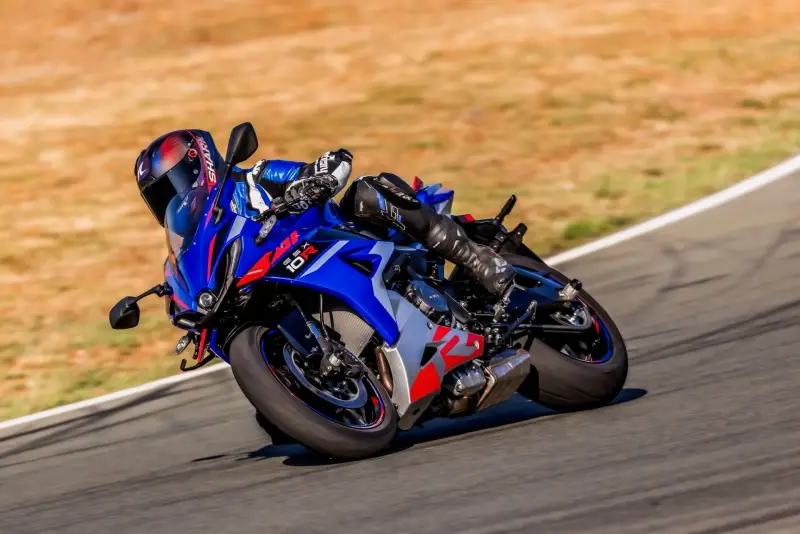
Suzuki’s GSX-10R, based on the GSX-S1000, sits one rung below the GSX-R1000 in the company’s sportbike lineup. Its new bodywork wraps the K5 engine in a fairing with an LED headlight and aerodynamic winglets, leaving part of the engine visible. In Euro 5+ form, the engine makes 152 hp and 78 lb-ft.
Electronic aids include traction control, a Lift Limiter anti-wheelie system, Roll Torque Control and Suzuki’s new Slide Control, which is designed to help manage rear-wheel slip. Three power modes, launch control and Engine Brake Control are also included. Cruise control, a speed limiter and Brake Hold Control for hill starts add everyday functions alongside the performance equipment.
The aluminum twin-spar frame and swingarm pair with fully adjustable KYB suspension, including a 43mm fork and rear monoshock, plus an electronically controlled steering damper. The rear tire grows from the GSX-S1000’s 190/50 to a 190/55. Blue, black and red are the listed color options.
New brands, electric bikes and rider equipment
Ultraviolette plans to bring motorcycles to the U.S. in 2027, but it hasn’t set a specific U.S. date for the X-47 Venom. The Indian electric motorcycle maker has said it intends to expand into North America after building its presence in Europe and other markets. The X-47 is one of the models identified for that expansion.
The electric X-47 Venom uses a UV Lightfury motor rated at 40 hp peak and 406 lb-ft of wheel torque after reduction gearing. Ultraviolette claims 146 miles of urban range on the WMTC urban cycle, a test figure that shouldn’t be treated as an EPA estimate. The battery case is die-cast aluminum and rated IP67. Charging comes from a 1.6kW onboard Type 2 charger, with an optional 3kW Boost Charger. Continuous motor output is 14.75 hp, which allows European A1 type approval.
Ultraviolette lists 0–62 mph acceleration in 5.9 seconds, a 96 mph top speed and a curb weight of 454 pounds. The company puts emphasis on the bike’s rear radar, which supports blind-spot detection, lane-change assistance, overtaking alerts and rear-collision warnings. Front and rear dash cameras, a rear-view camera with Park Assist and a 7-inch TFT touchscreen complete the equipment. U.S. homologation details and timing remain unconfirmed.
In&Motion showed a broader range of airbag systems for road, touring, off-road and competition use. Its systems are wireless and don’t rely on a tether to activate. The company’s new design, developed with Honda, uses adjustable sliders to fit different body types and riding styles and can be worn over or under compatible clothing.
Other products include the SRG-1 Max, developed with SHOT Race Gear for off-road riding; the Airscud ADV jacket made with Italian adventure gear brand T.ur; and Klim’s AI-1 airbag for road and adventure use. In&Motion also continues its Racing Legacy program, including motocross development. The source material reports that airbags will become mandatory in the World Championship from 2028 and cites a real-world accident study finding a 52 percent reduction in chest-injury risk.
Klim’s Roughkut line brings motorcycle protection into casual jackets and pants, with AA abrasion ratings and CE Level 1 or Level 2 armor. The collection includes a waxed-canvas Ironwood Jacket, the flannel-inspired Grindstone Riding Shirt and an expanded selection of denim riding pants. The approach is aimed at riders who want gear that works off the bike as well as on it. Roughkut is scheduled to reach the U.S. in early 2027.
Stampaggio Plastica Affini presented Stop&Up, an automatic electro-hydraulic stand designed by DDesing Lab. It raises a motorcycle into a vertical parked position and can adapt to uneven or sloping ground. Its wider spacing between support points is intended to increase stability, and its operation could help in tight parking spaces.
Use depends on set conditions: the engine must be running, the bike upright, the brake applied and both wheels stopped. A mechanical lock supports longer parking. If the system loses power or develops a fault, it can be disconnected and operated manually. The modular design is intended to fit different vehicle sizes and categories, while a tapered cover is meant to follow the bike’s shape.
More models to watch, with availability still open
SWM’s Stormbreaker Speciale adds full fairing and bagger styling to the V1200 cruiser. SWM traces its history to Milan in 1971, when Piero Sironi and Fausto Vergani founded the company. After production ended in 1984, the marque returned in 2014 under engineer Ampelio Macchi, with backing from China’s Shineray Group. SWM says it retains design, headquarters and assembly operations in Italy, at the former Husqvarna factory in Biandronno, Varese.
The Speciale’s round LED headlight sits in a sweeping fairing, with hard saddlebags, black paint and flame graphics outlined in gold. Its liquid-cooled, 1,200cc 45-degree V-twin makes 61.2 hp at 5,500 rpm and 66.4 lb-ft at 4,000 rpm, compared with 58.5 hp for the standard air-cooled sibling. A five-speed gearbox and wet multi-plate clutch transfer power.
The cruiser weighs 597 pounds ready to ride, with a 28.3-inch seat and 4.3 inches of ground clearance. It has a 3.7-gallon tank, 16-inch alloy wheels, a dual-disc front brake setup and dual-channel ABS. SWM lists a top speed of 103 mph. U.S. riders can find the brand through SWM USA and select regional powersports dealers; Speciale deliveries are anticipated sometime in 2027.
Chinese manufacturer Voge introduced the Brivido R800 as its entry into the medium-to-large naked-bike class. The parallel twin produces 95.2 hp and 60 lb-ft, with a claimed 127 mph top speed. Ride-by-wire supports four response modes, and the six-speed gearbox has a bidirectional quickshifter. The front end is marked by twin daytime-running-light signatures with integrated turn signals.
A steel-tube trellis frame, asymmetric aluminum swingarm and KYB upside-down fork form the chassis. Both the fork and rear shock adjust for preload and damping, and a steering damper is fitted. The bike has a 55.3-inch wheelbase, 414.5-pound curb weight and 32.5-inch seat height. Its color TFT connects to a smartphone and displays navigation information; a dash camera is standard.
Voge already has a limited U.S. presence through distributors and select dealers. Listed examples include the 300 Rally, with an MSRP starting around $5,499 through GPX Moto USA, and selected smaller motorcycles and scooters through other outlets. That establishes a route into the market, but no U.S. availability or price for the Brivido R800 has been announced.
The range at EICMA ran from motorcycles with firm U.S. schedules to concepts without production details. For buyers, the most useful next markers are the announced 2027 arrivals, U.S. pricing for models already confirmed for this market, and specifications that manufacturers have yet to release. The show made clear that middleweight adventure and road bikes are expanding quickly, while electronics and rider equipment are becoming a larger part of the buying decision.


