Aptera Ride Reveals 400-Mile Range Target and Early 2027 Deliveries
- Christopher Smith
- 822 views
Aptera’s solar EV is nearing customer builds, with a $40,000 Launch Edition targeting 400 miles and deliveries planned for early 2027.

Aptera’s long-promised solar electric vehicle has reached a more meaningful stage: a ride in a near-production validation vehicle, alongside a plan to build its first 40 units. The company says customer deliveries are expected in early 2027. For prospective buyers, the key questions now are whether Aptera can turn its unusual three-wheel design into repeatable production and how much of its headline range will hold up in daily driving.

The green Launch Edition that drove through Las Vegas during the SEMA show looked substantially more finished than an earlier Aptera test mule. Its roof integrates 700 watts of solar panels, and the cabin has a completed interior. The ride was a passenger trip, not a drive, so it offered a look at fit, finish and operation without a chance to assess steering or handling from behind the wheel.
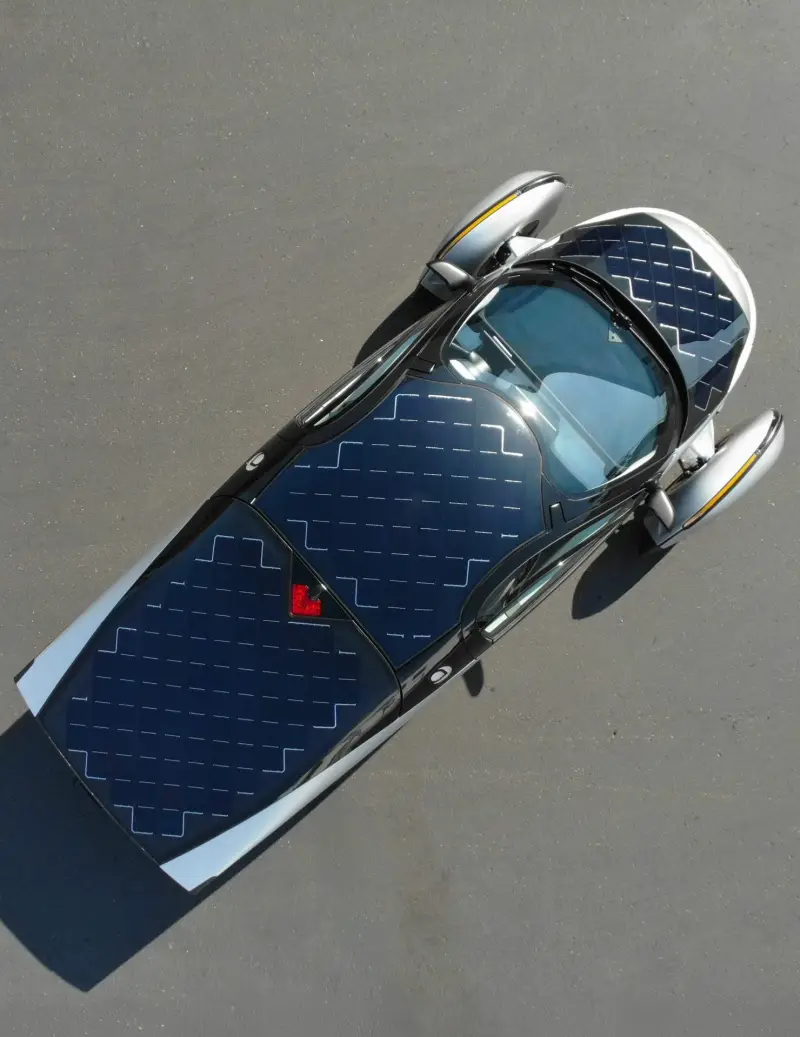
Aptera’s stated starting target for this first Launch Edition is $40,000, with a claimed range of 400 miles. The company has also discussed a later version priced at $28,000, but that figure hasn’t been repeated recently. Buyers weighing the vehicle against conventional electric cars will need to wait for firm pricing and production details, as well as clarity on which configurations will be available first.
Range depends on conditions
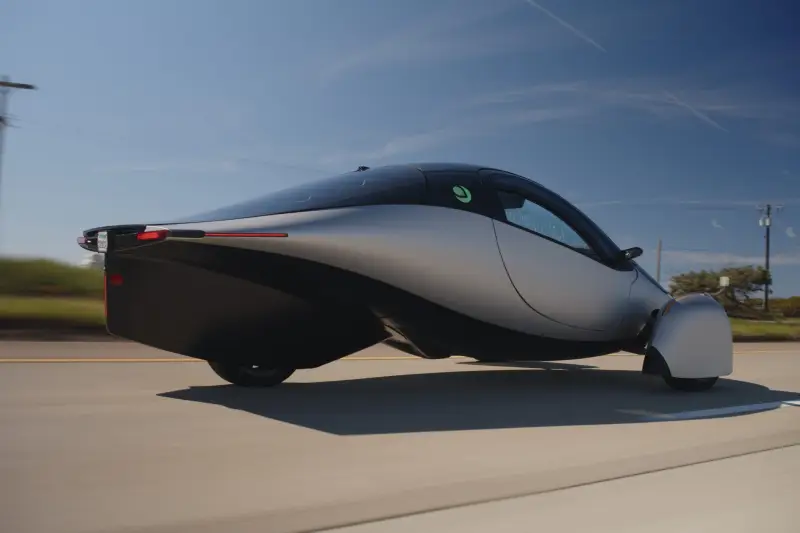
The car weighs about 2,200 pounds and uses a 44-kWh battery made from LG Chem 2170 cylindrical lithium-ion cells. Aptera says the vehicle can cover 300 to 400 miles, depending on speed, terrain and use of the air conditioning. Chief marketing officer Chris McCammon said the company has achieved 400 miles and expects efficiency of 10 miles per kilowatt-hour at its target. He said Aptera plans to release data on that result shortly.
That efficiency claim is central to the vehicle’s appeal. McCammon contrasted the target with a figure of four miles per kilowatt-hour for most EVs. The car’s very low weight and streamlined body are intended to reduce energy use, but the range estimate still needs to be judged against the route and conditions behind it. McCammon specifically pointed to elevation: Las Vegas sits about 2,000 feet higher than Carlsbad, California, and a climb can affect the energy required for a trip.

The solar panels add useful energy, but they don’t make the Aptera a vehicle that can drive indefinitely on sunlight alone. In bright Las Vegas conditions, the roof display showed solar input ranging from 250 to 325 watts. Aptera says the array can generate more than four kilowatt-hours in a day, a result it says was independently measured by TÜV, the German standards organization. The company also describes solar contribution as enough for up to 40 miles of driving per day. Actual benefit will depend on sunlight and how the vehicle is parked and used.

The Las Vegas trip itself provided a practical example of the car’s charging needs. The vehicle had been driven from San Diego with a single charging stop in Barstow. McCammon said it could have completed the route without stopping if it had begun with a full battery. That makes the trip evidence of a substantial drive between cities, while also showing that the starting charge matters.

Three wheels, unusual packaging
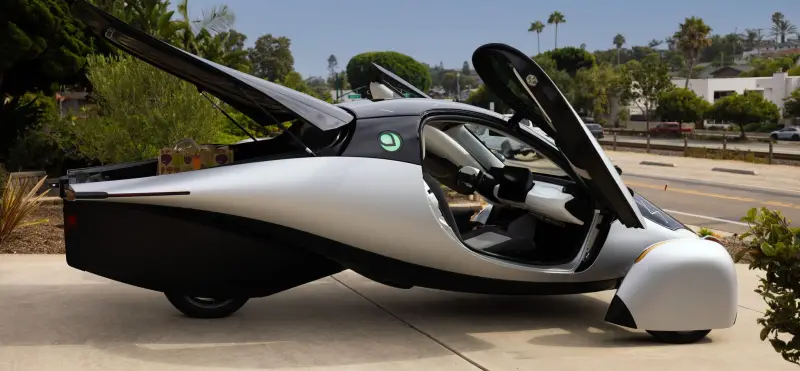
Aptera’s layout sets it apart from mainstream EVs and other three-wheelers. Its two front wheels are driven electrically, while a Polaris Slingshot seen on the Las Vegas Strip uses a gasoline engine to drive its single rear wheel. The Aptera’s enclosed cabin and air conditioning also made it more comfortable on the ride than an open-sided Slingshot, particularly in hot weather.

The vehicle’s exterior uses 195/50R tires from Hankook on 16-inch wheels, covered by aerodynamic spats. That’s a change from the bicycle-like tires on an earlier prototype. McCammon said Aptera is still looking for a more efficient tire and estimated that tire choice could improve range by 10 to 20 percent. That potential gain makes tire selection more than a finishing detail: it could affect the distance drivers get from each charge.
Aptera lists a drag coefficient of 0.13, which it describes as the lowest for a production car. Rearview cameras replace conventional mirrors, reducing items that sit in the airflow. The company has also placed the suspension’s pushrod shocks and springs inside the body, keeping them out of what McCammon called the vehicle’s dirtiest airflow. He described the packaging as having some racing-car influence.
Validation vehicle still needs refinement
The ride vehicle had working Bluetooth and operating audio, and McCammon said its software was close to the production version. It was still a validation vehicle, though, and a hard strike over a rain gutter sent a sharp impact through the cabin. McCammon said the suspension was harsh and that the production units were being built with a revised setup offering more travel. That change will matter on ordinary broken pavement, where occupants will notice suspension behavior more than the vehicle’s aerodynamic numbers.
Aptera describes the structure as an aluminum chassis with a battery pack installed from below, a carbon-fiber tub and a carbon-fiber internal structure, covered by an exterior fiberglass shell. McCammon said the doors include steel reinforcement for side impacts, while the front structure has crash rails and foam. He said the design is intended to meet selected passenger-car safety standards, including frontal offset and frontal side-impact tests, although Aptera is not required to perform those tests. No results were provided during the ride.
The vehicle’s low profile also raises practical questions in traffic. From behind a Ford Bronco, the Aptera sat notably low, prompting concern about how it would interact with taller vehicles in a collision. Its structure and intended crash testing are relevant, but buyers will need test results to understand how the finished vehicle performs. The ride offered no basis for comparing its protection with that of a passenger car, motorcycle or neighborhood electric vehicle.
Production is the next test
Aptera says it has parts in hand to begin building the first 40 vehicles at its Carlsbad facility, with that work expected to start within weeks of the SEMA appearance. The company’s stated delivery target is early 2027, which McCammon clarified as the first quarter rather than a promise of January deliveries. He said Aptera would like to move faster, but is assembling the initial supply chain and parts for the first customer vehicles.
The Carlsbad site covers 80,000 square feet and has 14 assembly stations. Aptera says suppliers will provide some large assemblies ready for installation, including the chassis and dashboard. The full vehicle is expected to use 136 subassemblies across those stations. Around 60 to 70 people were working at the site, with 10 assembly technicians focused on validation vehicles at the time of the ride.
Those details make the first 40 builds the immediate measure of progress. A completed validation car and a long drive to Las Vegas show that the program has moved beyond early prototypes, but a small initial run will test whether supplied components, assembly steps and revised hardware come together consistently. For buyers who have placed deposits, the practical milestone is not another range claim: it’s the start of customer production and a delivery schedule that holds.


