Göpel Barcuda VP230 Combines PCBA Programming, Testing and 60A Power
- Zahra Awan
- 335 views
Göpel’s Barcuda VP230 combines programming, boundary-scan and functional tests, with up to 60A supplied through its test adapter.
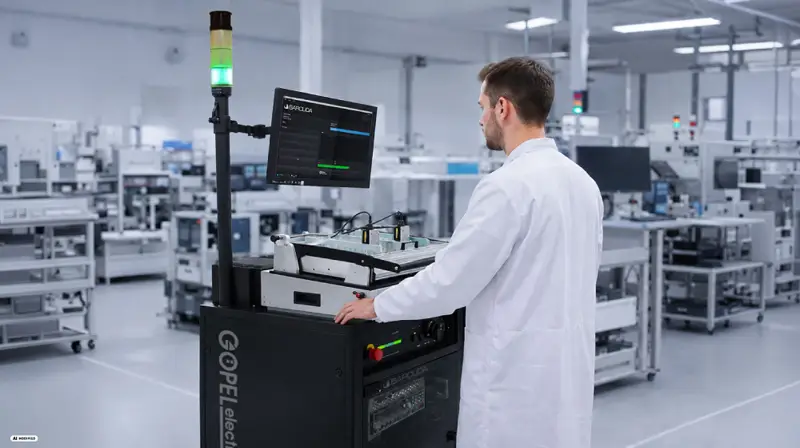
Testing a powerful printed circuit board assembly (PCBA) can require more than a pass or fail check. Production teams may need to program the board, run boundary-scan and functional tests, measure signals, and supply enough current to reproduce demanding operating conditions. Göpel Electronic’s Barcuda VP230 PowerBlade brings those tasks together in one production tester, with an integrated supply capable of delivering up to 60A directly to a PCBA through the adapter system.
That current capacity is a central feature for applications such as AI hardware and other power-intensive electronics. High-performance computing modules, accelerator cards and complex embedded systems can be tested and programmed while receiving substantial power through the test adapter. The stated maximum is 60A; the system description does not give a voltage range, power rating or test duration, so those details will matter when teams assess suitability for a particular board.
One system for programming and test
The VP230 combines programming, boundary-scan testing, functional test procedures and high-current power in a turnkey setup. Its Barcuda series foundation uses Göpel’s boundary-scan technologies, while the platform can also support embedded JTAG, digital and analog test functions, and customized hardware solutions. That mix gives production teams a configurable starting point for standard applications as well as specialized manufacturing and validation work.
Putting these capabilities into a single test environment can simplify the sequence from programming through final functional checks. It also gives teams a way to coordinate several kinds of tests on the same assembly rather than treating programming, electrical checks and functional validation as disconnected tasks. The practical value will depend on the board, the required coverage and how the test sequence is configured; the product description does not specify test times or quantify throughput.
The Scanflex II controller manages complex test sequences, and measurement cards support analog voltages and digital inputs and outputs. Together, these components extend the tester beyond basic connectivity checks. They give teams tools to assess electrical behavior and exercise functions as part of the production process, while keeping programming and test activities within the same setup.
Adapter flexibility and mechanical tests
The standard interface is Göpel’s G12 adapter interface from Virginia Panel (VPC). The interface gives users flexibility in choosing an adapter supplier and in meeting mechanical requirements for individual applications. That matters because fixtures and adapter designs must match the board under test and the production setup. The interface choice provides a defined connection point, while the specific adapter remains part of the application design.
For tests that involve physical movement, an optional integrated pneumatic unit can control up to 16 actuators within the test adapter. These actuators can support automated sequences involving moving elements, switches, contacts or other mechanical stimuli. This adds a physical test dimension alongside electrical measurement and programming, which can be useful when a board’s operation depends on components being pressed, moved or switched during validation.
The pneumatic option is not described as standard equipment, and the number of actuators alone does not establish what a particular test can cover. Teams will need to match actuator placement and sequence design to the assembly and its test requirements. The available details also do not specify cycle times or the range of mechanical forces involved.
Production workflow and traceability
Göpel says the redesigned user interface is intended to help production staff carry out test procedures with less training. A clearer operator workflow can matter on a production line, where a tester needs to support repeatable execution across shifts and users. The description does not provide usability measurements or training-time comparisons, so the benefit is best read as a design aim rather than a quantified result.
The system can also be integrated with existing manufacturing execution systems (MES) and database systems. That connection can support traceability by associating production and test results with the broader manufacturing record. For plants already using those systems, integration may help keep test information within established data workflows; the specific interfaces and integration effort will depend on each site’s setup.
Operational safeguards are another part of the design, particularly given the combination of high current and optional pneumatic actuation. These features are intended to support operation in a production environment, though the available product details do not describe individual safeguards or define operating limits.
The VP230’s clearest proposition is breadth: programming, boundary-scan, analog and digital measurement, functional testing and high-current supply in one production tester, with pneumatic actuation available when a test requires it. For buyers evaluating the system, the next questions are application-specific: whether the 60A supply meets the board’s needs, which measurements and sequences are required, and how the adapter and data connections fit the production line.


