Infineon and Synopsys Bring Aurix RC1 Software Development Forward With Virtual Prototype
- Zahra Awan
- 308 views
The Aurix RC1 VDK lets teams start software work before silicon is ready, with up to 90% of validation possible ahead of physical systems.
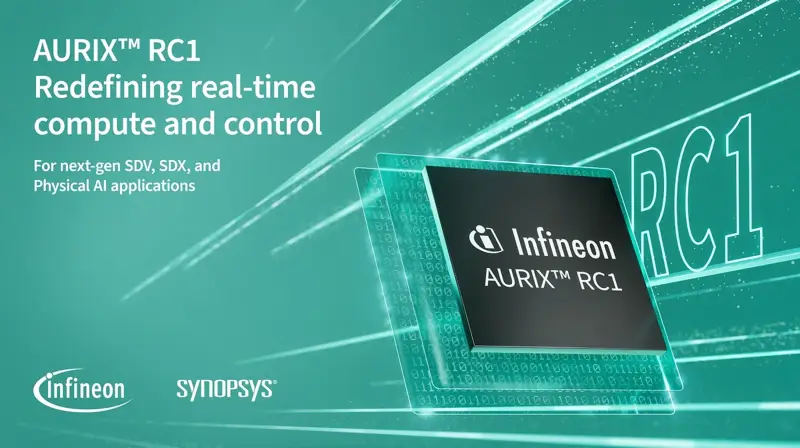
Infineon’s Aurix RC1 microcontrollers will have a virtual development kit from Synopsys, giving automotive teams a way to begin software work and validation before physical chips are available. The timing matters: vehicle software now spans many suppliers and domains, and waiting for hardware can leave integration problems until late in a compressed development schedule.
The Virtualizer Development Kit, or VDK, models the new MCU family so engineers can evaluate it, build software for it and test that software in a virtual environment. Infineon and Synopsys say up to 90% of software validation can take place before physical systems are ready. That figure describes the potential validation completed in advance; it doesn’t mean every final check can be done without hardware.
Earlier software work, broader system checks
The VDK is intended to support work across multiple vehicle electronics domains. Teams can assess the RC1 platform before silicon availability, helping inform platform selection, while software teams can start implementation and validation without waiting for physical parts. The partners also describe the kit as a basis for virtual electronic control units, or vECUs, and larger electronics digital twins.
Those stages matter because software has to work across an interconnected vehicle architecture, rather than only on an individual controller. A virtual ECU can give teams a model on which to develop and check software; a wider electronics digital twin can extend that work across more of the vehicle’s electronic system. As the virtual setup grows, teams can examine software interactions earlier and give ecosystem partners a chance to assess compatibility.
That earlier feedback can help expose integration issues while teams still have room to address them in development. It can also reduce dependence on physical test vehicles for work that a virtual model can support. The VDK is integrated into Infineon’s Drivecore software portfolio, placing it within the company’s broader software offering for customers and ecosystem partners.
Cost and schedule implications
Infineon and Synopsys frame virtualization as a response to the scale of current automotive software development: the industry is managing more than 600 million lines of code, hundreds of suppliers, shorter schedules and cost pressure. With AI and software taking on a larger role in vehicle functions and differentiation, waiting for hardware before starting substantial software work can constrain progress across a program.
The partners say large automakers often spend hundreds of millions of dollars each year on physical test vehicles, with more than half of that spending going to software and electronics. They estimate that virtualizing vehicle electronics for design, integration and testing can reduce these costs by 20–60%. That range is their stated estimate; the savings a team achieves will depend on how much of its development and test work can be carried out virtually.
Virtual prototypes don’t remove the need for physical hardware. Their practical value is in moving suitable development and checks earlier, then using physical systems where hardware behavior needs to be evaluated. For programs with many software contributors, that can give teams more time to uncover compatibility issues and refine their work before physical integration becomes the main focus.
A longer collaboration around Aurix
The RC1 VDK builds on more than a decade of work between Infineon and Synopsys on virtual prototypes for Aurix microcontrollers. Synopsys tools have supported development around Infineon’s multicore real-time cluster architecture, and the companies have also delivered Infineon-validated virtual prototypes for the Aurix and Traveo MCU families.
RC1 brings a new architectural direction to that relationship. Infineon describes the family as an open architecture based on RISC-V, supported by a growing ecosystem of software, tools and services. Vice president of software and ecosystem management Thomas Schneid said the aim is to let customers build on existing investments, simplify migration and accelerate development on Aurix RC.
For automakers and Tier 1 suppliers, the next measure will be how well the virtual model supports their actual software stacks and vehicle electronics. The stated 90% validation potential and projected cost reductions make the kit’s reach an important point to assess. Its value will ultimately depend on how much development teams can complete in the virtual environment before they need physical systems.


