Tesla Roadster Stunts Look Physically Plausible, but Production Claims Remain Unproven
- [email protected] (Kiran Menon)
- 580 views
An engineering breakdown finds plausible physics behind the Roadster’s stunts and acceleration claims, with major caveats around assumptions, road conditions and delivery.
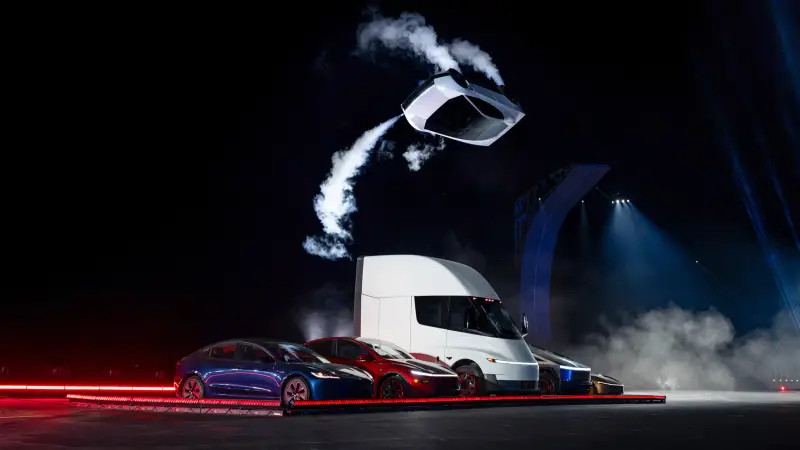
The Tesla Roadster’s upside-down display, brief flight and claimed 0–60 mph run of 0.81 seconds are physically plausible on paper, according to calculations by Jason Fenske of Engineering Explained. That’s a narrower conclusion than proving the production car can repeat the demonstrations: key vehicle specifications are still unavailable, and the estimates depend on assumptions about its size, mass and hardware.
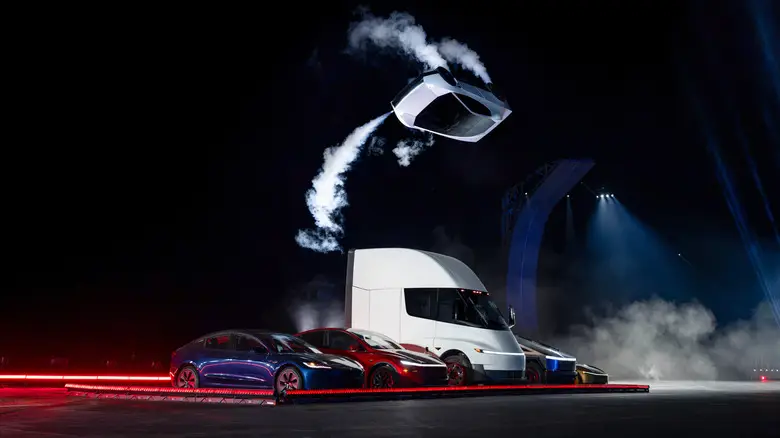 Image: Tesla
Fenske’s analysis offers a useful way to read the spectacle. The stunts draw attention, but each rests on a different engineering constraint: fan driven suction for the inverted display, stored nitrogen for the airborne maneuvers, and enough grip or thrust to produce the advertised acceleration. The calculations suggest those mechanisms could work under the conditions shown. They don’t settle how well the systems would perform on ordinary roads, or whether the demonstrated configuration matches a customer car.
How the car could stick to the ceiling
For the upside-down demonstration, Tesla’s system uses fans to draw air from beneath the car. Deployable skirts seal off the area, helping the fans create lower pressure under the vehicle than above it. The resulting pressure difference pushes the car against the surface.
Using the downforce figures presented at the demonstration and an assumed skirt area, Fenske estimates a pressure difference of about 11.5 kilopascals. With atmospheric pressure near 100 kPa, that would put pressure beneath the car at roughly 88.5 kPa, or about an 11.5% vacuum relative to the air above it. On those assumptions, the Roadster needs only a partial vacuum to remain inverted.
Fenske also calculates that reducing the pressure beneath the car all the way to zero could theoretically produce as much as 90,000 kilograms of downforce. That figure describes the limit of the pressure calculation, not the force needed for the displayed stunt or a practical operating target. The demonstration’s estimated pressure is far less extreme.
That distinction matters for interpreting the feat. The basic physics can support the display without establishing that the same force, reliability or surface contact would be available during normal driving. The analysis uses an estimated sealed area, while Tesla has not provided the vehicle dimensions and other specifications needed to pin down the result.
Nitrogen supply and the airborne stunts
The flight and kickflip demonstrations rely on stored nitrogen in the Roadster’s Rocket configuration. Fenske’s estimate assumes 250 kilograms of nitrogen held at 10,000 pounds per square inch in two tanks. With an estimated flow rate of 37 kilograms per second, that supply would support about seven seconds of hovering.
Both maneuvers took around four seconds in the demonstration, leaving the estimated supply within reach of the time shown. Fenske therefore considers the stunts plausible. The calculation still depends on the stated nitrogen mass and flow rate, along with assumptions about the car. Larger tanks or a lighter body could change the result, but the available information doesn’t establish whether either was part of the demonstration setup.
Those details are central to the gap between a short display and a road car. A brief burst of thrust can be assessed against a finite tank supply; repeated use raises a separate question about how much propellant is available each time. The analysis addresses whether the demonstrated sequence could fit within the estimated supply, rather than what frequent use would mean for an owner.
Acceleration estimates depend on the configuration
Fenske’s estimates for the Roadster’s variants vary sharply. For a Base model, which has not been confirmed as a production version, his calculation gives a maximum acceleration of 0.99 g and an estimated 0–60 mph time of about 2.76 seconds. For the Performance version, equipped with fans, he estimates 2.3 g and roughly 1.2 seconds.
The Thrust version is the configuration tied to the 0.81-second claim. Fenske connects the proposed 3.37 g acceleration to the nitrogen system’s estimated flow. His calculation suggests that around 40 kilograms of nitrogen could provide 1 g of thrust for one second, while a 200-liter storage tank would have enough capacity to support the claimed run under his assumptions.
For the Rocket variant, Fenske estimates a 0–60 mph time of 0.5 seconds, with acceleration reaching 5.5 g. That’s an especially demanding figure, and it remains a modeled estimate rather than a result independently established by production specifications. Across the variants, Fenske notes that factors such as tire friction and pressure distribution could materially affect the actual acceleration.
These figures also describe different hardware packages, so they shouldn’t be treated as one Roadster specification. The fan system, nitrogen storage and assumed vehicle setup influence what each version could do. Until Tesla provides production details and the cars are tested in a defined configuration, the estimates show what the proposed systems might achieve, not what buyers can count on.
Road conditions and ownership questions remain
The fan system’s practical limitations could be more consequential than the headline downforce number. Fenske points out that the skirts and fans are wear items, and debris can reach the fans even when the system filters incoming air. A demonstration surface also provides more controlled contact than the uneven roads a car encounters in everyday use. Changes in surface quality could affect the seal and, in turn, the downforce.
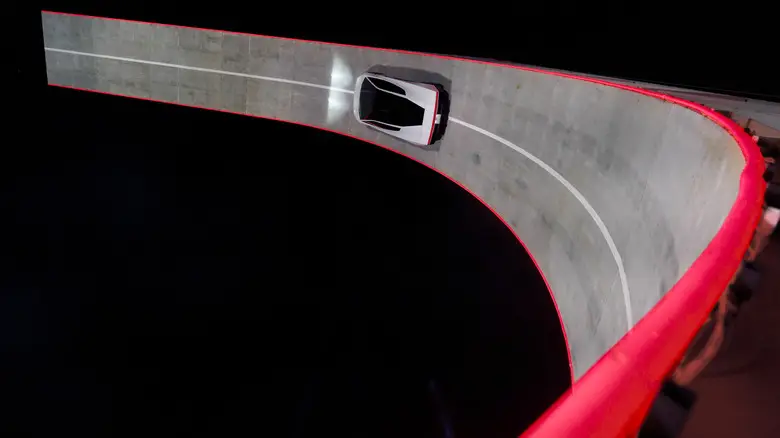 Image: Tesla
Range and body style add another set of buyer questions. Tesla vice president of vehicle engineering Lars Moravy told Top Gear that the new car would have around 310 to 320 miles of real-world range. The design is described as a T-top, and seating will vary by version: the car is expected to be a two-seater or, depending on the model, a single-seater.
Tesla says the Roadster is due to enter production in 2028, and Elon Musk has claimed the production car will exceed what appeared at the demonstration. Those statements sit alongside a history of Roadster specifications changing or failing to arrive as promised. Earlier expectations for the previous Roadster included four seats and 620 miles of range; the new model’s reported seating and range figures point in a different direction.
For now, the engineering breakdown supports a limited but meaningful read: the stunts aren’t ruled out by basic physics, yet the estimates rely on information Tesla hasn’t fully supplied. Surface performance, component wear, variant specifications and real-world range will matter more to buyers than a single staged run. The decisive evidence will come when production cars arrive with confirmed specifications and can be assessed outside a controlled demonstration.


