Matt Hagan Renews Call to Reconsider Funny Car Body Tethers After Terry Haddock Crash
- Richard Davis
- 829 views
Terry Haddock’s qualifying crash has renewed Matt Hagan’s call to change Funny Car body tethers, which he says can block drivers’ view and control.

Terry Haddock’s crash during Funny Car qualifying has brought a long-running safety dispute back into focus: whether body tethers can keep carbon-fiber debris from reaching spectators while making it harder for a driver to see and control a damaged car. Matt Hagan, a multi-time Funny Car champion, renewed his demand for the NHRA to remove the tethers after Haddock’s car exploded and struck a wall late Saturday.
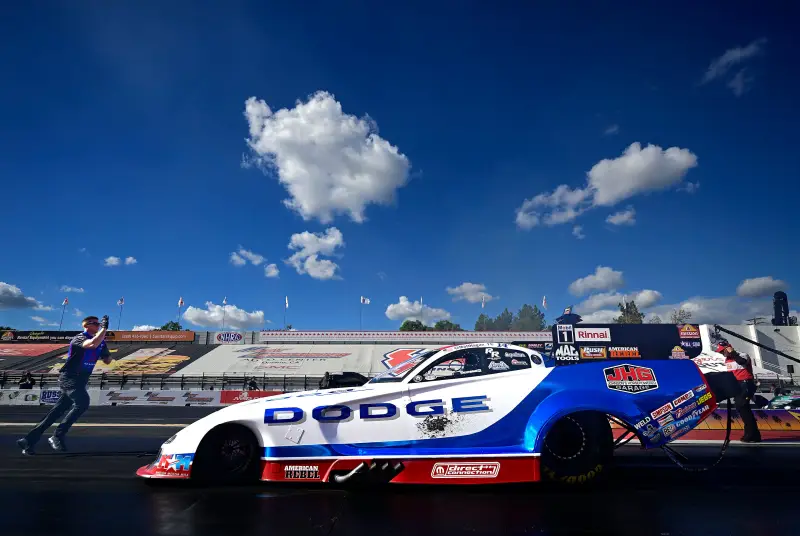
Haddock was attempting to qualify for the 16-car field when his car suffered what appeared to be a valvetrain failure. The body did not separate cleanly from the chassis. Instead, large sections of carbon fiber folded inward around the cockpit as the car burned, obstructing Haddock’s view while he was still moving on the track.
Haddock hit the wall before stopping and getting out. He was unhurt. The crash nevertheless illustrated the specific concern Hagan has raised: a driver dealing with an engine failure may have limited visibility, impaired steering and no clear path to stop. That combination can turn an already serious mechanical failure into a loss of control.
Hagan argues the tethers leave drivers trapped
Hagan addressed the incident on social media Sunday morning. He said the tethered body can prevent drivers from seeing or steering, keep parachutes from deploying, and leave them trapped inside the car. He also warned that a driver who cannot tell which direction the car is facing could create a collision risk for another racer sharing the track.
His objection is aimed at the way the system behaves during a catastrophic failure. Tethers keep bodywork attached rather than allowing it to fly away, a design intended to limit the danger to fans and other people near the track. In Haddock’s crash, Hagan argued, that restraint caused the damaged body to collapse around the driver and obstruct his view.

Hagan had raised the issue before, but his earlier comments called for racers and the NHRA to work together on a solution. This time, he used a sharper tone and urged the organization to remove the tethers. He also suggested moving fans farther from the track or restricting ticket sales beyond the 300-foot point, presenting those measures as alternatives to leaving drivers with blocked visibility.
The tradeoff is difficult: debris that separates from a car can endanger spectators, while bodywork that stays attached can interfere with a driver trying to manage a fire or stop a damaged vehicle. The incident has renewed the question of whether the current setup provides enough protection inside the cockpit when a Funny Car breaks apart.
Haddock describes the loss of visibility
After the crash, Haddock said he had never experienced an explosion in which the body remained attached in the same way. He described being unable to see where the car was going, then hitting objects. He apologized to fans for the effect of the incident on the event, while saying his team would repair the damage and work toward returning to competition.
Eight-time Top Fuel champion Tony Schumacher, watching from the announcer booth, quickly predicted that the crash would restart discussion about tethers. He said observers could not see Haddock in the car, and Haddock could not see out. Hagan also reacted soon after the crash, saying the experience made him question climbing back into a Funny Car.
The concern predates Haddock’s incident. The source of the debate stretches back to a similar situation involving retired driver Johnny Gray, and other racers have faced comparable conditions. Hagan has been the most outspoken Funny Car driver on the issue, but the account of Haddock’s crash gives the debate a fresh example of the practical problem: a driver may need to navigate a damaged car at the same moment that the bodywork limits the view.
A difficult balance remains unresolved
The NHRA has used body tethers to balance driver protection with the safety of fans and bystanders. Hagan’s position is that the balance has shifted too far away from the driver. Any change would have to address both sides of that problem: keeping loose carbon fiber from reaching people near the track while giving a driver a workable view and a chance to control the car after a failure.
That is the central issue for teams and track operators as the discussion continues. Haddock escaped without injury, but the crash exposed how little control a driver may have when bodywork folds inward and blocks the cockpit. Hagan says the tether system needs to change; the next step is finding a way to reduce debris risk without leaving drivers unable to see where they are going.